Many founders approaching a CMO hire are asking the wrong question. They research job descriptions, scan LinkedIn titles, and benchmark salaries against competitors. What they rarely do is define what commercial outcome they're actually buying. The title tells you what someone will be called. It says almost nothing about whether pipeline grows, sales cycles shorten, or the business becomes less dependent on the founder to close every deal. Understanding what a chief marketing officer actually does, and what distinguishes the role from other senior marketing titles, is the more useful starting point.
This article covers the full picture: what the CMO role actually owns in revenue terms, how it differs from other senior marketing titles, realistic UK salary ranges for 2026, the career path that gets someone to the seat, and when a fractional arrangement beats a full-time hire. That last question has sharpened considerably in recent years, as embedded fractional models have made the outcomes of senior marketing leadership visible and accountable from the outset, rather than buried in a twelve-month probation period.
What a CMO actually owns in a B2B scale-up
A typical job description for this role lists brand management, campaign execution, and team leadership. These are inputs. In a B2B scale-up, a chief marketing officer is accountable for three commercial outcomes: a growing, qualified pipeline; a shorter, more repeatable sales cycle; and a brand that makes both outbound and inbound motion cheaper over time. Founders who hire on activity descriptions end up with someone who is busy rather than someone who is effective. The distinction matters enormously when you're paying £150,000 or more for the role.
ICP and targeting
Defining precisely who the business goes after, and why, is the foundation of any productive GTM motion. Without a tightly drawn ideal customer profile, campaigns scatter and pipeline quality suffers. This is a strategic call that sits with the most senior marketing leader, not the demand generation team.
Messaging and positioning
Why buyers move is a question of positioning. The chief marketing officer owns the narrative that makes the commercial case, shapes sales conversations, and differentiates the business in a crowded market. Messaging that isn't anchored to buyer evidence doesn't convert; it just fills a content calendar.
GTM architecture
How pipeline gets built and measured — which channels, what sequences, how attribution works — is the operating system of revenue growth. A senior marketing leader designs and owns that architecture, including the RevOps infrastructure that makes performance visible.
Sales and marketing alignment
How leads become revenue rather than internal disputes is arguably the most politically sensitive responsibility. The most effective chief marketing officers embed themselves in the sales conversation, reviewing lost deals, sitting in discovery calls, and building the feedback loops that keep both teams calibrated.
Together, these four areas represent levers the role either pulls directly or enables the team to pull consistently. The role only produces outcomes when it carries commercial authority, access to sales data, and a mandate tied to revenue KPIs — CAC, pipeline velocity, win rate, and marketing-sourced revenue contribution. Without those conditions, you have a senior marketing manager at chief marketing officer cost.
A frequently observed issue in B2B scale-ups with £2M to £15M ARR is hiring a senior marketing leader to "run marketing" rather than to own pipeline architecture. The result: a brand budget and a content calendar, but no pipeline growth. Then everyone wonders why. Your marketing team needs senior firepower to close that gap.
CMO vs marketing director vs head of marketing
A chief marketing officer sits on the executive team and reports to the CEO. That placement matters because marketing strategy gets made in the room where commercial decisions happen, not cascaded down from it. A marketing director or head of marketing typically reports to a CMO or COO and executes against a strategy they didn't fully shape. In many B2B scale-ups, these titles are used interchangeably, which creates serious ambiguity about who owns the revenue growth mandate and who is responsible when pipeline stalls.
A chief marketing officer owns the commercial outcome — pipeline health, brand equity, revenue contribution — while a director owns the execution of specific channels or campaigns. A head of marketing often bridges both in smaller companies, but without board-level access or a commercial mandate, the strategic authority rarely follows the responsibility. You can give someone a big title and a small remit. What you can't do is expect senior strategic outcomes without the authority to match.
A "CMO" at a 20-person start-up may be doing what a marketing coordinator does at a 500-person firm. A "marketing director" at a large enterprise may hold more strategic authority than a chief marketing officer at seed stage. What matters is the mandate, the budget authority, and the KPIs the role owns. When evaluating senior marketing leadership for a B2B scale-up, define what you need to be true in 90 days before you settle on a title. The title is a negotiation. The outcomes are the contract. For teams looking to accelerate that transition, our Team Upgrade 30-Day Plan can be a useful operational template.
The career path to the CMO seat
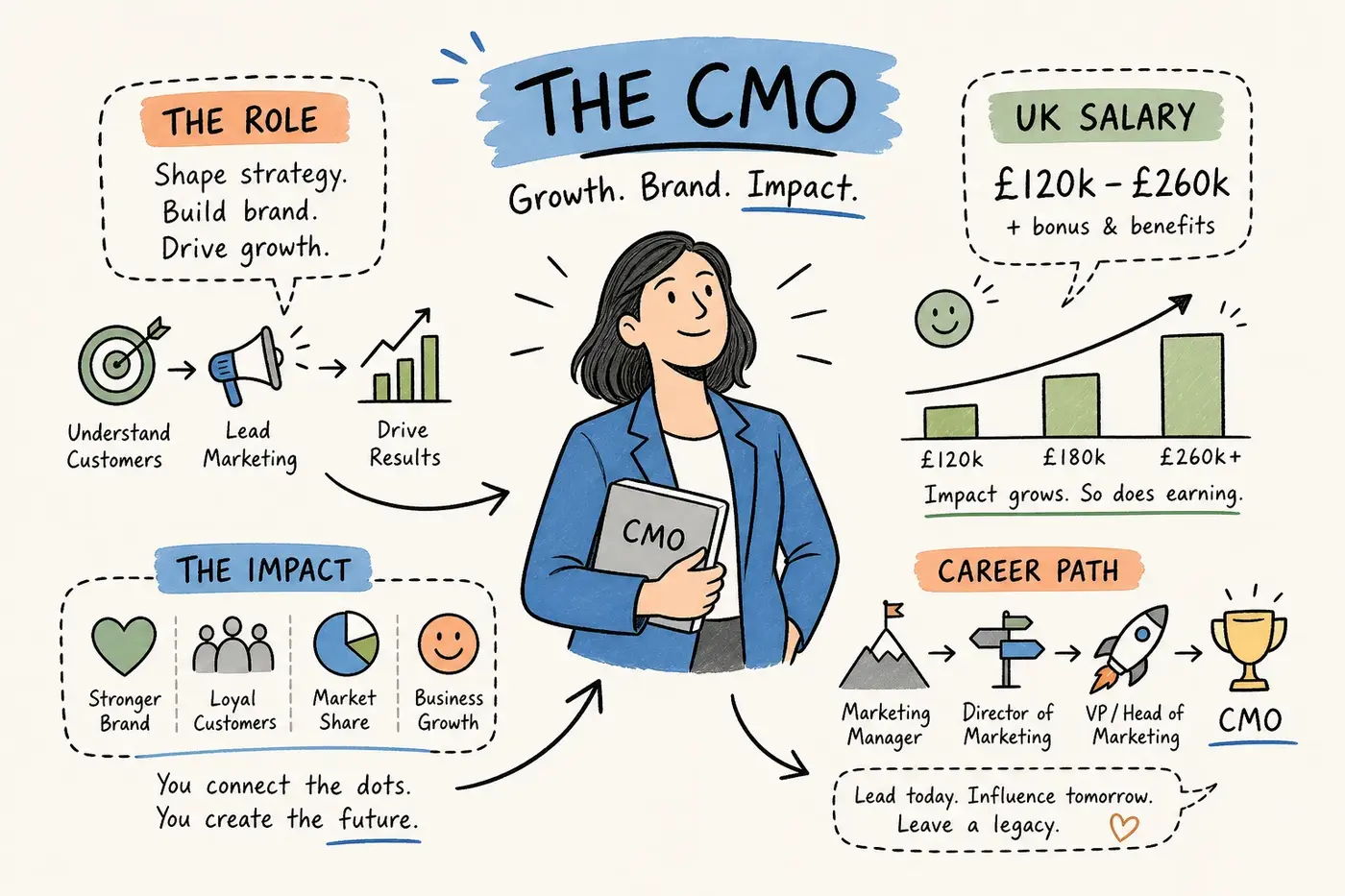
The path almost always moves through coordinator, marketing manager, director, and VP before reaching the most senior marketing role. The critical transition points are from manager to director, where you shift from running campaigns to owning commercial outcomes, and from director to VP, where you move from leading a function to leading a business unit. The VP or head of marketing role is the most important stepping stone because it demands the 360-degree business view needed at the top: budget ownership, cross-functional stakeholder management, and pipeline accountability that extends beyond marketing's own channels.
Most appointments to large-organisation CMO roles require 15 to 20 years of experience, and often more than 20 in large corporates. At growth-stage B2B companies, that window can compress to 10 to 12 years for candidates who take on commercial accountability early and carry an MBA or equivalent business training. The fastest routes tend to run through B2B SaaS or high-growth technology companies, where pipeline metrics are visible and career progression is tied to measurable results rather than tenure. When you can point to revenue attribution, you don't need years to prove yourself. For an external perspective on typical progression, see a representative CMO career path.
Technical marketing skills are table stakes. What accelerates appointments is a track record with commercial evidence: revenue attribution numbers, pipeline growth figures, successful GTM launches with documented outcomes. Boards and founders look for someone who can tell a coherent story about what changed in the business because of their decisions, not just which campaigns they ran. In final-round evaluations, boards and CEOs consistently name cross-functional communication, particularly with the CFO and sales leadership, as the differentiating factor between candidates.
What a CMO earns in the UK in 2026
UK chief marketing officer base salaries span a wide range depending on business size and stage. Mid-market companies with revenues between £30M and £200M typically pay between £120,000 and £220,000 in base salary, with total packages reaching £300,000 when bonuses are included. Large enterprises pay between £200,000 and £350,000 in base, with total compensation including long-term incentive plans reaching £550,000 or above. According to Robert Half's 2026 Salary Guide, the overall UK median sits at approximately £147,000, with the 25th percentile at £110,250 and the 75th percentile at £183,750. For further C-suite context, see this C-suite salary guide.
Sector and location shift the numbers meaningfully. FinTech and B2B SaaS consistently pay at the top of the market, with senior roles in these sectors often exceeding £180,000 to £220,000 in base salary. London carries a location premium of 15 to 25% over the rest of the UK, according to Robert Half's regional data. Consumer, retail, and non-profit organisations sit at the lower end of the range, often closer to the £120,000 to £140,000 base band. Equity and long-term incentive structures are far more common in technology and VC-backed businesses, which means total compensation can diverge significantly from base salary when comparing offers across sectors.
A fractional CMO engagement in the UK typically costs between £50,000 and £120,000 annually, or £3,000 to £10,000 per month depending on scope and hours (though senior specialist engagements can reach £20,000 per month). That represents a saving of 40 to 60% compared to a full-time hire when salary, employer National Insurance, and benefits are factored in. For scale-ups that need senior strategic leadership but cannot yet justify a £180,000-plus permanent hire, the cost comparison alone often makes the fractional route the more practical first move. Benchmarks for these arrangements are available at fractional CMO salary benchmarks.
When to hire a fractional CMO instead of a full-time one
There are five specific situations where a fractional arrangement tends to outperform a permanent hire:
- The founder is still the primary driver of pipeline and needs to step back without losing momentum.
- Marketing spend is growing but pipeline isn't keeping pace.
- A previous senior marketing leader has left and continuity is needed during recruitment.
- The business has raised a round and needs to accelerate GTM without a six-month hiring process.
- The team has tried multiple agencies but cannot connect spend to revenue outcomes.
When two or more of these conditions are true simultaneously, a fractional hire almost always wins on speed, accountability, and cost.
A fractional CMO isn't a part-time employee. As explored in what a fractional CMO really does in a B2B company, at its best it's senior commercial leadership embedded in the executive team on a defined scope with clear KPIs and an explicit handover plan. The engagement should produce tangible outputs: an ICP definition the sales team actually uses, a GTM architecture with pipeline targets and measurement frameworks, and a playbook the internal team can own and operate independently once the engagement ends. If the engagement doesn't end with those outputs, it's a retainer dressed up as strategy — a distinction worth pressing on before you sign anything.
The decision is about outcomes, not titles
A chief marketing officer isn't a title, it's a set of commercial accountabilities. Understanding what those are, what the role costs, and how the career ladder works helps both founders who are hiring and marketers who are building toward the seat. The salary data and fractional comparison aren't academic: they're a practical decision-making framework for the specific moment your business is in right now.
If you're evaluating senior marketing leadership for your B2B scale-up, the first question isn't "do I need a CMO?" It's "what revenue outcomes do I need someone to own, and what's the most efficient structure to get there?" Sometimes that answer is a permanent hire. Often, particularly at the £2M to £15M ARR stage, it's a senior fractional engagement that builds the system, hands it over, and leaves the team capable of running it independently.
If you're not ready for a permanent hire but need the outcomes now, the RUTTENS+ fractional CMO engagement is worth evaluating. Start with the free Book a conversation to identify where your revenue engine is leaking before you decide what kind of leadership your business actually needs.