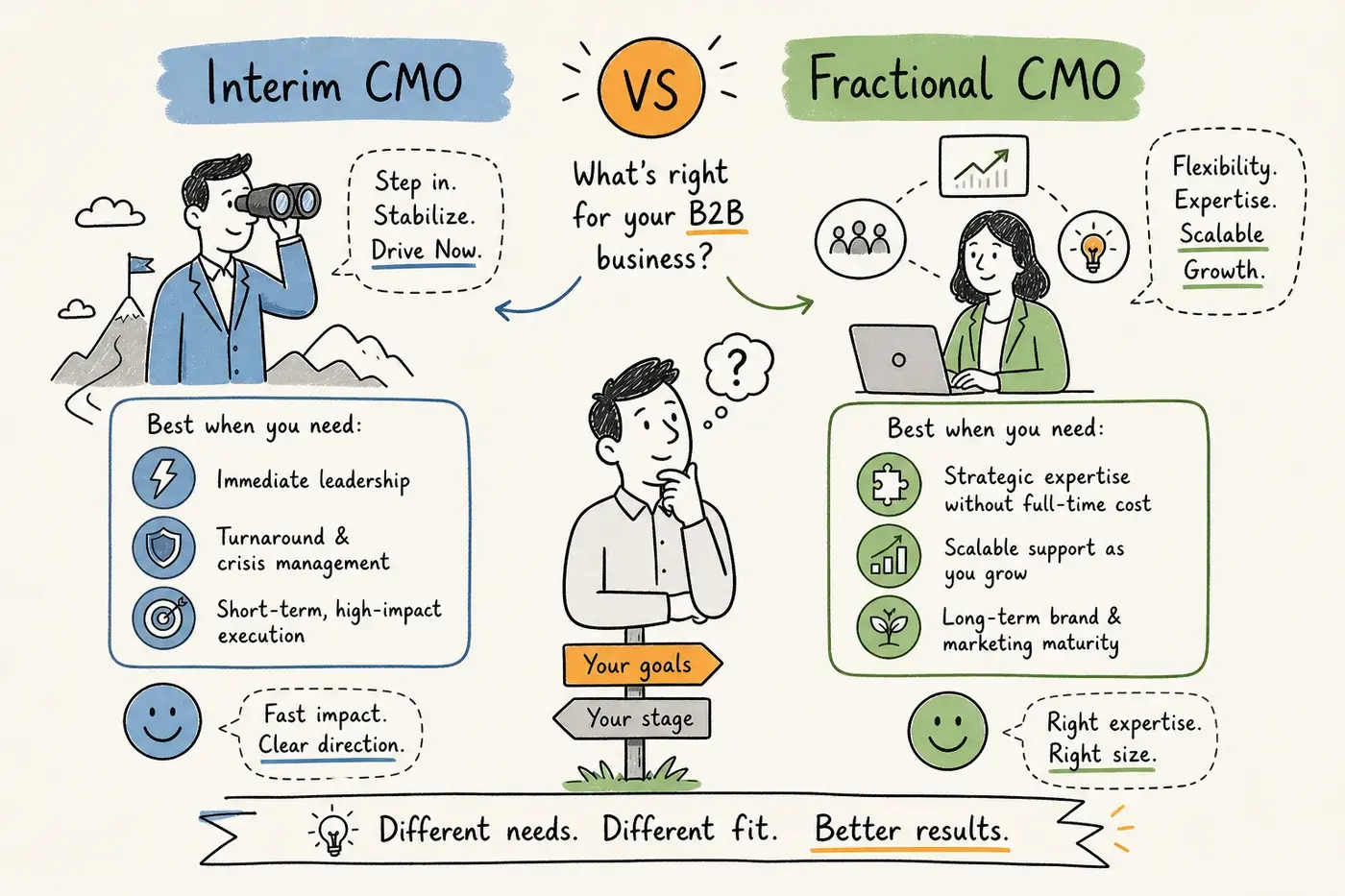
The CMO seat is empty. The board wants pipeline clarity. And two options have just landed in your inbox: an interim CMO and a fractional CMO. Both cost real money. But they are not the same solution, and choosing the wrong one will cost you far more than the engagement fee.
Many B2B leaders make this decision based on availability and day rate, rarely stopping to ask the question that actually matters: what will still be running after this person leaves? Getting that answer right is what separates a good hire from a costly mistake, and it is the question that practices like RUTTENS+ have built their entire engagement model around, designing every interim and fractional mandate so the team can own the revenue engine long after the engagement ends.
By the end of this guide, you will know which model fits your situation, what to budget for each, and how to tell a system-builder from a seat-filler before you sign anything.
The question most buyers don't ask before hiring an interim CMO
Ask most candidates what they will deliver and they will describe outputs: a new messaging framework, a demand generation programme, a board reporting pack. That is the seat-filler's answer. A system-builder gives you a different response entirely: infrastructure, documented playbooks, trained team members, and a pipeline engine that runs without them. Both are senior. Both have impressive CVs. Only one leaves your business in a stronger position when the engagement ends.
"Interim CMO", or interim chief marketing officer, has become a genuinely vague category. Some are experienced commercial operators who build clean go-to-market infrastructure before they exit. Others are competent executives who run campaigns, manage the team, and hand over a tidy slide deck. Both are legitimate approaches, but they serve entirely different business needs. The buyer has to know which problem they are actually solving before they even begin the search.
Use this diagnostic question in every conversation: "What will still be running six months after you leave?" A seat-filler answers with deliverables. A system-builder answers with processes, ownership structures, and the capability the team has developed to run the engine themselves. Those two responses reveal everything.
What an interim CMO is actually hired to do
An interim CMO is a full-time, temporary commercial operator, sometimes called a temporary CMO or interim marketing director. They own the marketing function directly, manage the team, control the budget, and report to the CEO or board. This is not an advisory role. It is an execution role with a defined end date, and the distinction matters enormously when you are writing the brief.
The core mandate covers demand generation, pipeline reporting, and team leadership. An interim CMO is not a campaign manager promoted above their grade; they are the accountable commercial operator for the entire function during a critical transition period. They make decisions, hold the team to standards, and represent marketing at the executive table from day one.
On costs, the UK market in 2026 is fairly consistent across engagement types. Standard interim mandates run at roughly £1,000 to £1,500 per day for a three to six month engagement. Transition or change-management assignments typically sit at £1,200 to £1,600 per day. Crisis or PE-backed mandates, where urgency and stakes are highest, command £1,500 to £2,000 per day on shorter two to three month contracts. Large corporates and FTSE-listed businesses can exceed £2,500 per day. These figures reflect the seniority and accountability the role demands, and are broadly consistent with published UK interim market guides.
How a fractional CMO works differently
A fractional CMO is not a cut-price interim. It is a structurally different engagement model. They work part-time, typically four to eight days per month, over a longer horizon of six to twelve months. Their leverage comes through the existing team, not above it. Where the interim CMO runs the function, the fractional CMO guides it.
The value of the fractional model compounds over time. Strategy sharpens, ICP definition tightens, the team develops stronger commercial instincts, and systems improve gradually rather than being installed in a sprint. Monthly retainers typically range from £3,000 to £10,000 depending on time commitment and seniority, with more experienced operators at the higher end of that band. This suits a business that already has some marketing infrastructure and needs elevation, not rescue.
The fractional model has real limits worth naming. If the marketing function is leaderless, the pipeline is in crisis, or the board needs accountability this quarter, a part-time presence is not sufficient. Fractional works when there is a capable team to guide and a functioning operating rhythm to improve. It struggles when there is nothing to build on and every decision is waiting for senior sign-off that only arrives once or twice a week.
Comparing the two models side by side
A useful way to compare the two is across three dimensions: what the person does day-to-day, what it costs across a six-month period, and what the business looks like after they leave.
| Interim CMO | Fractional CMO | |
|---|---|---|
| Commitment | Full-time, 3–6 months | Part-time, 6–12 months |
| Mode of operation | Runs the function directly; owns team, budget, reporting | Guides through the existing team; strategic direction and governance |
| Typical cost (6 months) | £125,000–£155,000 (at ~£1,200/day) | £18,000–£60,000 (at £3k–£10k/month) |
| Best fit | Structural gap, crisis, imminent fundraise or acquisition | Functional team needing senior direction; steady-state growth |
| What they leave behind | Stable function; handover brief for permanent hire | Sharper strategy; stronger team instincts over time |
The sharpest distinction, and the one most buyers miss entirely, is what each model leaves behind. A traditional interim CMO exits with a stable function and a handover brief for the incoming permanent hire. A system-builder, by contrast, leaves documented playbooks, a trained internal team, clean RevOps reporting, and a pipeline architecture the business can operate without external support. These are the criteria to apply when assessing every interim CMO candidate before you make an offer: not what they will do while they are with you, but what will still be working six months after they leave.
How to decide which model your B2B company needs
Choose an interim CMO when the gap is structural or urgent. The clearest signals are a CMO departure with no internal successor, a board demanding pipeline accountability in the current quarter, a fundraise or acquisition requiring senior commercial ownership within weeks, or a team that is active but directionless. The interim fills the leadership gap and runs the function directly from the moment they start.
Choose a fractional CMO when the gap is strategic rather than operational. Signs that point this way include a small but functional marketing team that needs a senior hand on the tiller, a founder or MD who is still close to commercial decisions but needs strategic challenge and external governance, or a business in steady state that cannot justify a full-time senior hire. The fractional CMO guides and elevates without taking operational control. If your team has the capability to execute but lacks senior direction, this is the more cost-effective model.
The question that forces clarity: does your marketing function need a driver or a navigator? If nobody is in the driver's seat right now, you need an interim CMO. If there is a driver but they lack a reliable map, a fractional engagement makes sense.
What a best-in-class interim engagement produces in 90 days
The gap between a seat-filler and a system-builder is most visible in how they structure the first 90 days. One manages the function. The other diagnoses, builds, and hands over, so the exit leaves the business in a better position than the entry found it.
In days 1 to 30, the priority is diagnosis before declaration. A strong interim CMO audits the pipeline, ICP clarity, messaging, channel performance, and team capability. They baseline CAC, MQL-to-SQL conversion, and pipeline velocity. No major launches happen yet, because the diagnosis informs every decision that follows. The output is a clear priority list and a first-principles view of where the commercial system is leaking.
In days 31 to 60, the building begins. ICP definition is sharpened or fixed entirely. Messaging is refined to reflect what actually resonates with the right buyers. Pipeline architecture, reporting cadence, and RevOps fundamentals are stood up. Sales and marketing are aligned on lead definitions and the handoff process so that the function stops haemorrhaging qualified pipeline between teams.
In days 61 to 90, the focus shifts to embedding and transferring. Live campaigns run with the internal team operating them. Playbooks are documented. The team is trained on the operating model. A board-ready report is produced with KPIs that the permanent hire or internal commercial lead can own from the day the engagement closes.
This is the model RUTTENS+ is built around. The commercial clarity approach framework, covering Target, Attract, Convert, Measure, and Handover, is designed to activate only the cylinders relevant to the client's growth stage. The Handover stage is not a courtesy; it is the explicit goal of every engagement. The aim is for clients to walk away with documented playbooks, trained teams, and a pipeline architecture they can operate without ongoing external support. In short, the system is designed to run after the work is done, not only while it is in progress.
Making the right decision: interim CMO or fractional?
The choice between an interim CMO and a fractional CMO is not fundamentally about cost or calendar days. It is about what your business actually needs: a function that operates at full capacity now, or a strategy that compounds steadily over time. Get the diagnosis right and both models deliver genuine value. Get it wrong and you have spent six figures, potentially the full cost of a standard interim engagement, on the wrong solution to the right problem.
If you need someone to cover the seat, a competent interim will serve you well. If you need someone to build the commercial system from the ground up, sharpen the ICP, fix the pipeline architecture, and hand it over so your team can run it independently, you need a different kind of engagement entirely. The builder's mindset is rarer than the market suggests. Vet for it explicitly before you commit.
Bring the current commercial question to a conversation. The next step depends on the situation.
Frequently asked questions
How long does an interim CMO typically stay?
Most interim CMO engagements run for three to six months. Crisis or PE-backed mandates are often shorter, two to three months, while more complex transformation assignments can extend to nine months if the scope demands it.
What is the cost difference between an interim and a fractional CMO?
A six-month interim engagement at a mid-market day rate typically costs between £125,000 and £155,000. A fractional retainer over the same period ranges from £18,000 to £60,000 depending on the commitment level. The gap is significant, but so is the difference in what each model delivers.
When should you hire a fractional CMO instead?
A fractional CMO makes sense when your team already has the capacity to execute but lacks senior strategic direction. If the marketing function is not in crisis and you do not need full-time senior presence, the fractional model is more cost-effective and compounds in value over a longer engagement horizon.