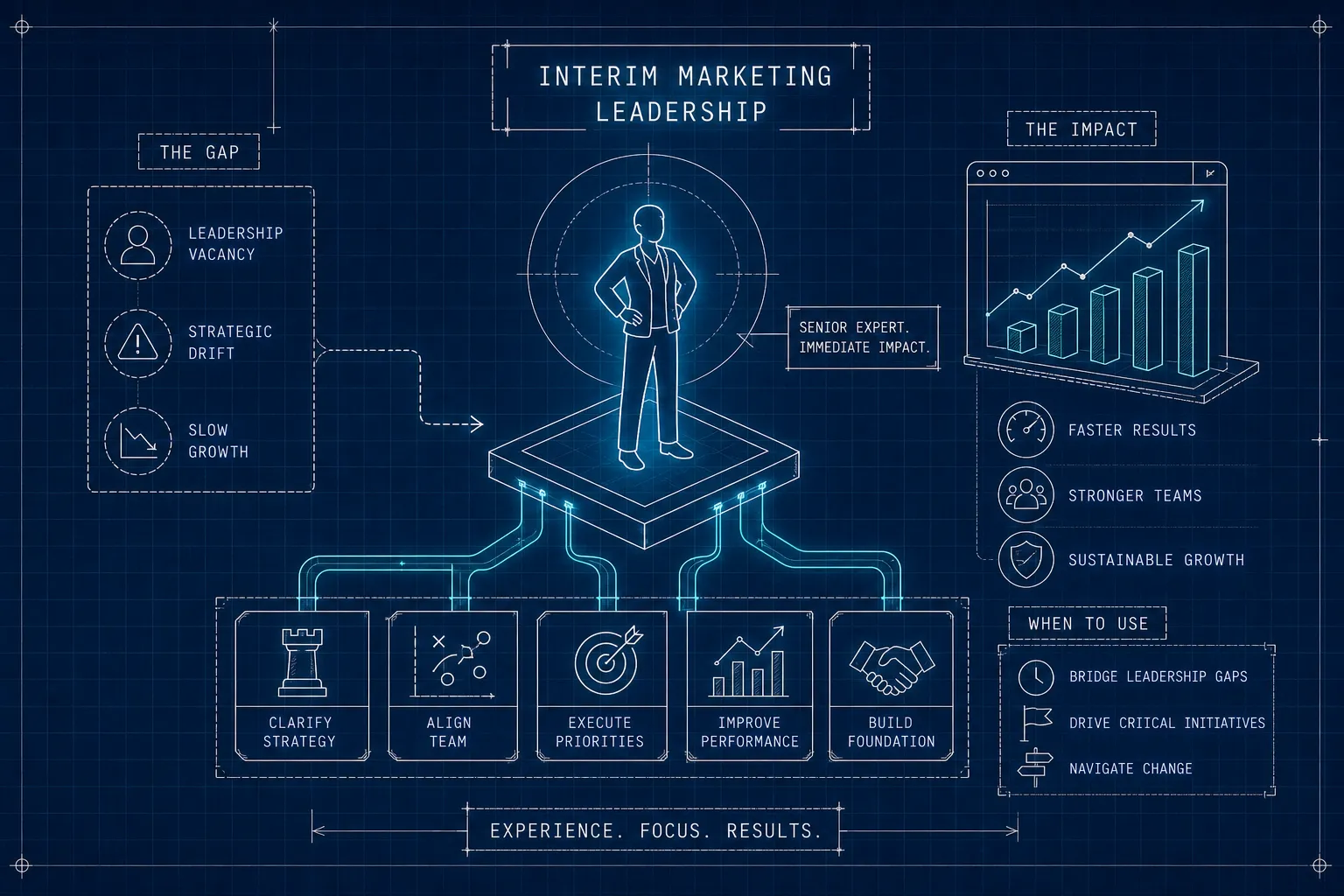
What is interim marketing leadership and when to use it
Your marketing director hands in their notice on a Thursday. The permanent replacement is realistically 12 to 16 weeks away. The board meeting is in six weeks, a major campaign is mid-flight, and two agency contracts are up for renewal. The instinct is to find someone quickly, get them in the chair, and worry about the rest later. That instinct is understandable, and it is precisely how interim marketing leadership gets misused.
At RUTTENS+, the question we hear most often from B2B leadership teams is not "how do we find an interim?", it is "what should the interim actually deliver, and how do we avoid wasting the window?" Some engagements end with little more than calendar management and a tidy handover note. The ones that do not share a common starting point: a brief written around outcomes, not availability. This article explains how to write that brief, what a well-scoped interim engagement looks like, and when it creates the most commercial value.
What interim marketing leadership actually is
An interim marketing leader is a senior marketing professional engaged on a fixed-term basis, typically full-time or near-full-time, to lead the marketing function during a transition. The critical word is lead. This is not a contractor handling execution work under someone else's direction. The interim carries the authority and accountability of the role itself: team ownership, budget sign-off, agency relationships, and board-level reporting.
The seniority distinction matters enormously in practice. An interim marketing manager operates at a functional and operational level. An interim marketing director or interim CMO holds strategic authority, makes decisions that affect the company's commercial direction, and is expected to contribute meaningfully to leadership discussions. Write the wrong brief and you will attract the wrong candidates. Titling the role "interim marketing manager" when you need director-level authority is not a minor error; it changes who applies and what they will do with their time.
Fractional CMO arrangements. Interim means full authority, full-time commitment, short term, typically three to six months. Fractional means part-time, ongoing strategic leadership, usually one to three days per week. "Temporary" is broader language that describes duration without saying anything about seniority, scope, or working model. An interim marketing consultant sits differently again: usually project-scoped and advisory-weighted, without operational ownership of the team or budget. None of these roles are interchangeable, and the brief you write should reflect the one you actually need.
The three scenarios where interim marketing leadership creates most value
The clearest use case is a planned absence: your marketing director is going on maternity or parental leave, you have a defined timeline, and the business has momentum worth protecting. The risk here is not sudden collapse, it is drift. Campaigns get quietly de-prioritised, agency relationships soften, and reporting becomes inconsistent. A well-scoped interim bridges that period without losing the strategic thread or damaging the institutional knowledge your permanent hire will need to inherit.
Post-departure gaps are more pressured. When the marketing lead leaves unexpectedly, the team is unsettled, knowledge transfer is absent, and a permanent search in the UK market realistically takes three to five months minimum. This is where bringing in an experienced interim leader earns its day rate fastest. A strong interim stabilises the team, assesses what is actually working, and keeps pipeline generation alive while the permanent hire process runs in parallel. The risk of doing nothing, or promoting internally before someone is ready, is often underestimated by leadership teams who do not want to "pay twice."
The third scenario is less discussed but arguably the most commercially valuable: pre-hire stabilisation. The business knows it wants a senior marketing leader, but it is not ready. The ICP is unclear, messaging is inconsistent across channels, and there is no reporting infrastructure worth showing to a board. Onboarding a permanent CMO into that level of ambiguity wastes the first six months of their tenure. An interim can de-risk the permanent hire by defining what the role actually needs to deliver, cleaning up the foundations, and handing over a functioning system rather than a blank slate.
UK rates, contract lengths, and what should be in scope
UK interim marketing director day rates in 2026 typically run between £700 and £1,000 per day, based on current specialist market data. Senior profiles with scale-up or commercial transformation experience command £850 to £1,300 per day, with some specialist CMO-level placements reaching £1,500 in higher-demand scenarios. Unlike agency retainers, where margin is layered on top of the underlying resource cost, interim engagements are usually structured as direct or near-direct arrangements. The rate reflects full accountability for the function, not billable hours on a task list.
Contract lengths and notice periods
Most interim marketing engagements run three to six months, with the full range sitting between three and nine months depending on complexity and whether the brief expands. Contracts are typically fixed-term with short or no formal notice periods; both parties need flexibility, and long notice terms defeat the purpose of interim work. Notice-period norms do vary, so it is worth clarifying expectations at the outset. Extensions are common when the permanent hire runs late or the brief grows, build that possibility into the initial agreement rather than scrambling to renegotiate mid-engagement.
From day one, scope should include strategy ownership, team leadership, agency management, budget accountability, and executive or board-level reporting. Many engagements also include contributing to the permanent hiring brief, because the interim has seen the role from the inside and understands what the business genuinely needs. If those elements are absent from the scope, question whether you need an interim leader or a senior contractor.
Why "holding the seat" is not enough
Most interims are skilled at maintaining what exists. They keep campaigns running, manage the team, attend the right meetings, and hand over a tidy inbox to the permanent hire. That is valuable when continuity is the only goal. It is not enough when the business needs to accelerate, reposition, or build something it does not yet have.
B2B companies with no coherent ICP definition, no repeatable demand generation system, and no RevOps infrastructure will not acquire those things from a maintenance-mode interim. The engagement simply is not structured to deliver them. The pipeline deteriorates slowly, the team treads water, and the permanent hire arrives to find the same structural problems that existed before the interim started.
The alternative is an interim mandate explicitly designed to build, not just hold. The mandate covers ICP clarity, messaging architecture, pipeline structure, and reporting frameworks, all completed and handed over before the permanent hire arrives. This is the model RUTTENS+ operates from. Rather than filling the seat and stepping back, the engagement is structured around the commercial clarity approach, Target, Attract, Convert, Measure, and Handover, as live deliverables. The permanent hire inherits a functioning commercial system, not a warm chair and a folder of good intentions.
The shift starts at the brief stage. Write it around outcomes, not activities. Not "lead the marketing function" but "define ICP, build a pipeline generation system, and produce a 12-month GTM plan for the incoming CMO." That framing shifts the engagement from availability to accountability, and it attracts a meaningfully different calibre of candidate.
Where to find credible interim marketing leadership in the UK
Several UK agencies focus specifically on senior interim marketing placements. tml Partners typically introduces qualified interim executives within days. Exec Capital quotes a three-to-four-week typical appointment timeline for interim CMOs, with urgent candidates available within 48 to 72 hours. Coreus publishes a 94% offer-accept and start rate. Suzie Walker Executive Search delivers first shortlists within five to ten working days, with over 90% of their work coming from repeat clients and referrals. These firms work well when you have a clearly scoped brief and need a credible shortlist quickly, prospective clients should verify current metrics and timelines directly with each agency.
Assessing candidates effectively
When assessing candidates, prioritise those who ask about outcomes rather than responsibilities. Someone focused on what they will hand over at the end is fundamentally different from someone focused on what they will manage during the engagement. Check for evidence of delivery in a comparable B2B environment; an interim CMO with a B2C or large-enterprise background may not translate effectively into a 50-person B2B scale-up. References should specifically address speed to impact, not just the quality of the work once the person had settled in.
For companies that need both leadership continuity and active GTM system-building during the same window, a senior-led consultancy model operates differently from a traditional recruitment placement. The engagement is structured around deliverables from the outset, with explicit knowledge transfer built into the design. That is worth considering when the permanent hire is still months away and the business cannot afford to lose that time to maintenance mode.
How to measure impact in the first 90 days
Qualified pipeline volume and stage conversion rates are the clearest early indicators. If the interim is moving leads forward effectively, pipeline health should improve within six to eight weeks of the engagement starting. CAC trajectory and reporting reliability matter equally: if the business now has a functioning dashboard and can trace spend to pipeline, that is tangible infrastructure with value independent of whatever the pipeline numbers show in the short term.
Execution velocity is the softer but equally important signal: are campaigns shipping on time, are agency relationships being managed proactively, is the team more settled than when the interim arrived?
A practical 90-day phase structure
- Days 1, 30: Baseline established, analytics validated, key funnel gaps identified, priorities agreed with leadership.
- Days 31, 60: Quick wins launched, channel and budget choices tightened, sales alignment strengthened.
- Days 61, 90: Early commercial evidence visible, qualified pipeline movement, conversion improvement, and a repeatable reporting rhythm in place.
A clear handover document at 90 days is a strong indicator that the engagement was scoped for outcomes. The best interim arrangements end with the business in a stronger commercial position than if leadership had promoted internally or left the seat empty while the permanent search ran its course.
The decision in front of you
Interim marketing leadership is not a fallback option. When scoped correctly, it is a deliberate commercial decision that can accelerate the business rather than simply maintain it. The difference between the two outcomes is not the quality of the candidate. It is the quality of the brief you write before you start the search.
Bring the current commercial question to a conversation. The next step depends on the situation.