Most B2B operators are already running some version of go-to-market operations. They just haven't named it, which means nobody owns it and nothing connects. GTMOps is the function that converts your GTM strategy into a running system, and the gap between teams that have it and teams that don't shows up directly in pipeline quality and revenue predictability.
At RUTTENS+, this is the gap we encounter most consistently with scale-ups from our client work: capable teams, a functioning CRM, live campaigns, a sales motion in place, but no connective tissue holding it all together across the full buyer journey. The pieces exist. The operating layer does not.
This article gives you a working definition of go-to-market operations, a clear distinction from RevOps and why the difference matters, the responsibilities and tech stack the function should own, the metrics it should track, and a practical 90-day framework to start building it.
What GTMOps actually means
GTMOps, short for go-to-market operations, is the function that converts GTM strategy into execution by managing the processes, data, systems, and analytics that support the revenue motion across the full buyer journey. It is not a single role or a software licence. It is a cross-functional operating layer that spans sales, marketing, customer success, and often product as a launch and lifecycle partner.
The day-to-day scope includes CRM and pipeline management, lead routing, marketing automation, forecasting support, territory planning, cross-functional reporting, and handoff management between teams. If RevOps sets the rules, GTMOps runs the motion. That distinction matters more than most operators realise, and it is worth unpacking in detail.
In terms of organisational structure, GTMOps typically reports into a CRO or COO, depending on how the business is set up. That reporting line matters because the function needs cross-functional authority to work. At smaller scale-ups, one generalist or a fractional operator often holds the entire GTMOps remit informally, before it becomes a named function with a defined scope and ownership.
GTMOps vs RevOps: where the lines really sit
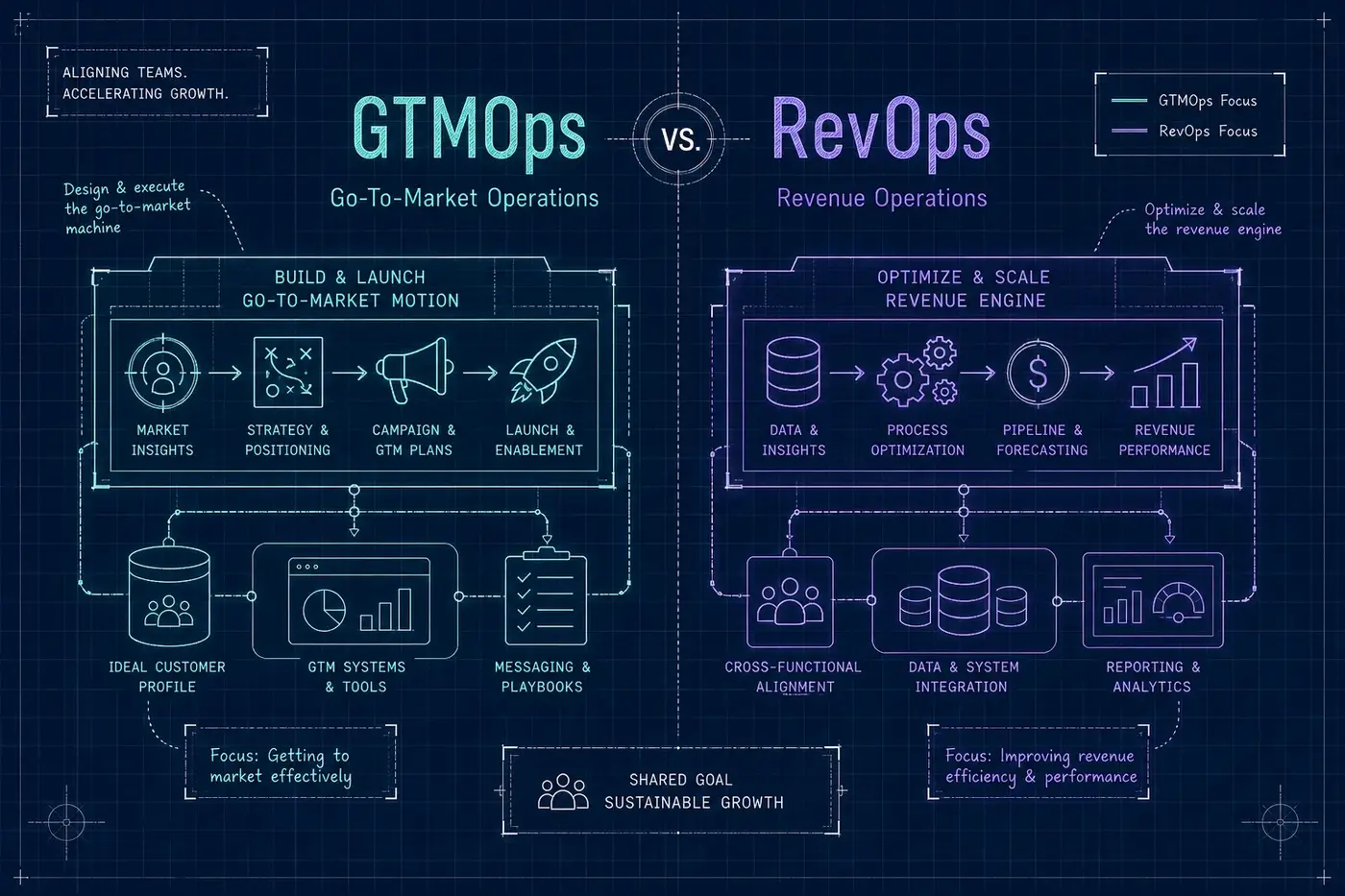
Many operators conflate these two functions, which is understandable, the terminology overlaps and companies use the titles inconsistently. RevOps is the governance layer: it sets the rules, defines funnel stages, enforces SLAs, manages forecasting, and keeps the CRM and tech stack consistent across the revenue organisation. GTMOps is the execution layer: it runs the motion, manages campaign operations, territory and quota support, lifecycle handoffs, and the systems that connect marketing demand to sales pipeline to customer success expansion.
A simple comparison makes the boundary clearer:
| Function | Primary scope | Core responsibilities | Typical reporting line |
|---|---|---|---|
| GTMOps | Entire go-to-market motion | Campaign operations, territory and quota support, enablement, funnel orchestration, data and tooling | CRO or COO |
| RevOps | Revenue lifecycle across teams | Process design, CRM governance, stage definitions, SLAs, forecasting, reporting | CRO or COO |
| Sales Ops | Sales team only | Territories, compensation, pipeline reporting, CRM hygiene, sales process | VP Sales or CRO |
| Marketing Ops | Marketing team only | Automation, campaign ops, lead scoring, attribution, platform management | CMO or VP Marketing |
One important caveat: companies use these titles differently. In some organisations, GTMOps is essentially a rebranded, broader RevOps team. In others, RevOps is the strategic governance layer and GTMOps is the execution layer underneath it. What matters is clarity of ownership, not the label on the org chart.
On the question of which to build first: at seed and Series A, one generalist RevOps hire typically covers both functions adequately. The distinction becomes meaningful at Series B and beyond, when volume and complexity justify splitting responsibilities. Build RevOps first if your business has conflicting funnel definitions, unreliable reporting, or broken handoffs. Conversely, build a dedicated GTMOps layer once you have operational discipline and need stronger motion design, launch coordination, and cross-functional orchestration.
What a GTMOps function owns day to day
The practical work of go-to-market operations covers six core areas, each protecting a specific outcome in the revenue system. CRM administration and data hygiene protect the integrity of your pipeline visibility. Lead routing and SLA enforcement protect speed-to-lead, which directly affects conversion rates. Campaign operations and enablement support protect the quality of demand generation output.
Territory management and forecasting inputs protect quota attainment and hiring decisions. Handoff management between marketing, sales, and customer success protects conversion at every stage transition. Cross-functional reporting protects the business's ability to make decisions from accurate data.
Most B2B scale-ups have the tools to cover all of these areas. What they lack is the operating layer connecting them. Leads fall into routing gaps. Handoffs between marketing and sales break silently. No one owns the pipeline coverage number until the forecast meeting reveals a problem. These are GTMOps failures, not sales or marketing failures.
A concrete example: a company with HubSpot, an SDR team, and a demand generation programme running paid and content channels. No agreed SLA on lead response time. No routing rules. No single owner of the MQL-to-SQL conversion rate. The CRM has data but the data is incomplete and nobody trusts it. That is a company with GTM activity but no GTMOps function, and the symptoms are exactly what you would expect: unpredictable pipeline, inconsistent conversion, and a leadership team that cannot diagnose where the system is breaking.
The GTMOps tech stack: layers and how they connect
The most common mistake in building a GTMOps stack is treating it as a tool-selection exercise rather than an architecture decision. The tool choice matters less than the answer to three questions: what is your source of truth, what flows where, and who owns data quality. With those answered, the layered architecture becomes straightforward.
The five functional layers are:
- CRM (system of record): HubSpot, Salesforce, or Pipedrive, depending on your stage and complexity
- Automation and orchestration: Zapier, Make, n8n, Workato, or Default to move data, route leads, and trigger workflows
- Analytics and attribution: HockeyStack, Looker, Tableau, or Bizible to connect activity to revenue outcomes
- Data warehouse: Snowflake, BigQuery, or Databricks to centralise and model data for reporting and activation
- Enrichment and activation: Clay, Apollo, ZoomInfo, Clearbit, 6sense, or Hightouch to enrich records, detect intent, and push modelled data back into GTM tools
Well-established integration patterns include HubSpot combined with Clay for seed and Series A teams, CRM foundation plus data enrichment and orchestration, and Salesforce combined with 6sense for enterprise ABM and intent-driven activation. Snowflake or BigQuery combined with Hightouch suits warehouse-first activation where modelled data syncs back into operational tools. At mid-market in 2026, the default stack tends to be HubSpot or Salesforce, Apollo or ZoomInfo, Clay, an engagement tool such as Outreach, and a BI or attribution layer.
The mental model to keep: CRM as the source of truth, enrichment and orchestration layer in the middle, engagement tools on the edge, analytics and warehouse underneath. Build in that order and the architecture is coherent. Reverse it and you get an expensive collection of point tools that do not talk to each other.
The metrics GTMOps should own
GTMOps should own the operating scorecard, not just the top-line revenue number. The core metrics below cover the system from demand creation to closed revenue to retained and expanded revenue. These are the measures that tell you whether the GTM motion is working, where it is breaking, and what to fix first.
Start with these seven:
- Pipeline coverage ratio: total open pipeline divided by quota. A common rule of thumb is 3x to 4x, meaning £4M in open pipeline against a £1M quota, though the right ratio will vary by motion, ACV, and sales cycle length.
- Pipeline velocity: opportunities multiplied by average deal value multiplied by win rate, divided by average sales cycle length. This tells you how fast revenue is moving through the funnel.
- MQL-to-SQL conversion rate: SQLs divided by MQLs. This is the handoff metric that reveals whether marketing and sales share a definition of a qualified lead.
- Opportunity win rate: closed-won deals divided by total opportunities. Segment by source, rep, and segment to find patterns.
- Sales cycle length: average days from opportunity creation to close. Rising cycle length is usually the first signal of a positioning or process problem.
- CAC and CAC payback period: total GTM spend divided by new customers, and CAC divided by monthly gross margin per customer. These protect acquisition efficiency.
- NRR: starting ARR plus expansion minus contraction minus churn, divided by starting ARR. GTMOps without a retention metric is only watching half the revenue system.
Segmenting these metrics by source, customer segment, and region is where GTMOps turns data into operational decisions. A flat MQL-to-SQL rate of 30% tells you little. A 50% rate from one channel and 12% from another tells you exactly where to focus.
Building GTMOps in 90 days: a practical starting framework
Open-ended GTMOps transformations stall because nothing has a deadline and everything feels equally urgent. A 90-day build forces prioritisation: identify the one or two areas causing the most drag, fix the data foundation, and get the operating rhythm in place before adding complexity. the same approach RUTTENS+ applies when building commercial infrastructure with B2B scale-ups.
The RUTTENS+ approach to commercial clarity that maps directly onto the GTMOps function as a structured build methodology. The five cylinders are Target, Attract, Convert, Measure, and Handover. Target covers ICP definition, territory logic, and account prioritisation. Attract covers demand generation systems, content infrastructure, and campaign operations.
Convert covers pipeline management, routing, handoff SLAs, and sales process alignment. Measure covers the KPI framework, CRM hygiene, attribution, and the GTMOps scorecard. Handover covers playbooks, team training, and capability transfer so the system runs without the consultant or founder in the room.
The framework is designed so that scale-ups activate only the cylinders relevant to their growth stage, rather than trying to build everything at once. A Series A company with no ICP clarity starts at Target. A Series B company with ICP clarity but broken handoffs starts at Convert. The entry point depends on where the drag is greatest, not on a templated sequence.
If you are building from scratch, the first three actions are: audit your current CRM data quality and completeness, define who owns each handoff point in the buyer journey, and establish the seven-metric GTMOps scorecard before touching the tech stack. The tooling problem is almost never the real problem. The ownership gaps and undefined handoffs are.
Start with the diagnosis, not the build
GTMOps is the execution layer your B2B revenue engine runs on. RevOps is the governance layer that keeps it consistent and measurable. Most B2B operators need both, but they need to name them, assign clear ownership, and build the operating infrastructure that connects them before adding more tools or headcount to the system.
The commercial clarity approach gives scale-ups a structured way to build that infrastructure in 90 days without starting from scratch and without building everything at once. The starting point is a clear-eyed view of where your GTM motion is breaking, not a technology evaluation or a headcount request.
Bring the current commercial question to a conversation. The next step depends on the situation.