What a Fractional CMO Really Does in a B2B Company
a fractional CMO becomes the most logical next step, not because full-time headcount is wrong in principle, but because the timing and cost rarely align. Campaigns are running, someone is posting on LinkedIn, perhaps an agency is involved, but there is no strategic ownership, no coherent ICP, and no clear line between marketing activity and pipeline. The instinct is to hire a senior marketing leader. The reality is that a full-time CMO costs £230,000 or more in total compensation before a single ad has been bought, and material impact often appears only after several months, commonly six or more into the hire-to-ramp cycle.
A part-time chief marketing officer, often called an outsourced CMO or fractional CMO, sounds like the obvious answer. The model is growing fast: demand for fractional executive roles in the UK has risen significantly year-on-year since 2020, and B2B companies between £2M and £15M in revenue are the most active buyers. But the role is widely misunderstood. Leaders conflate it with a marketing consultant, treat it like a cheaper full-time hire, or engage one without understanding what good delivery actually looks like. This guide fixes that.
Modern fractional CMO engagements have also shifted structurally. The strongest models are built around a defined handover stage: the system, playbooks, dashboards, and team capability are transferred before the engagement closes, so the internal team can run the pipeline engine independently. That is a meaningful design choice, and it is worth understanding before you hire anyone.
What a fractional CMO actually owns in your business
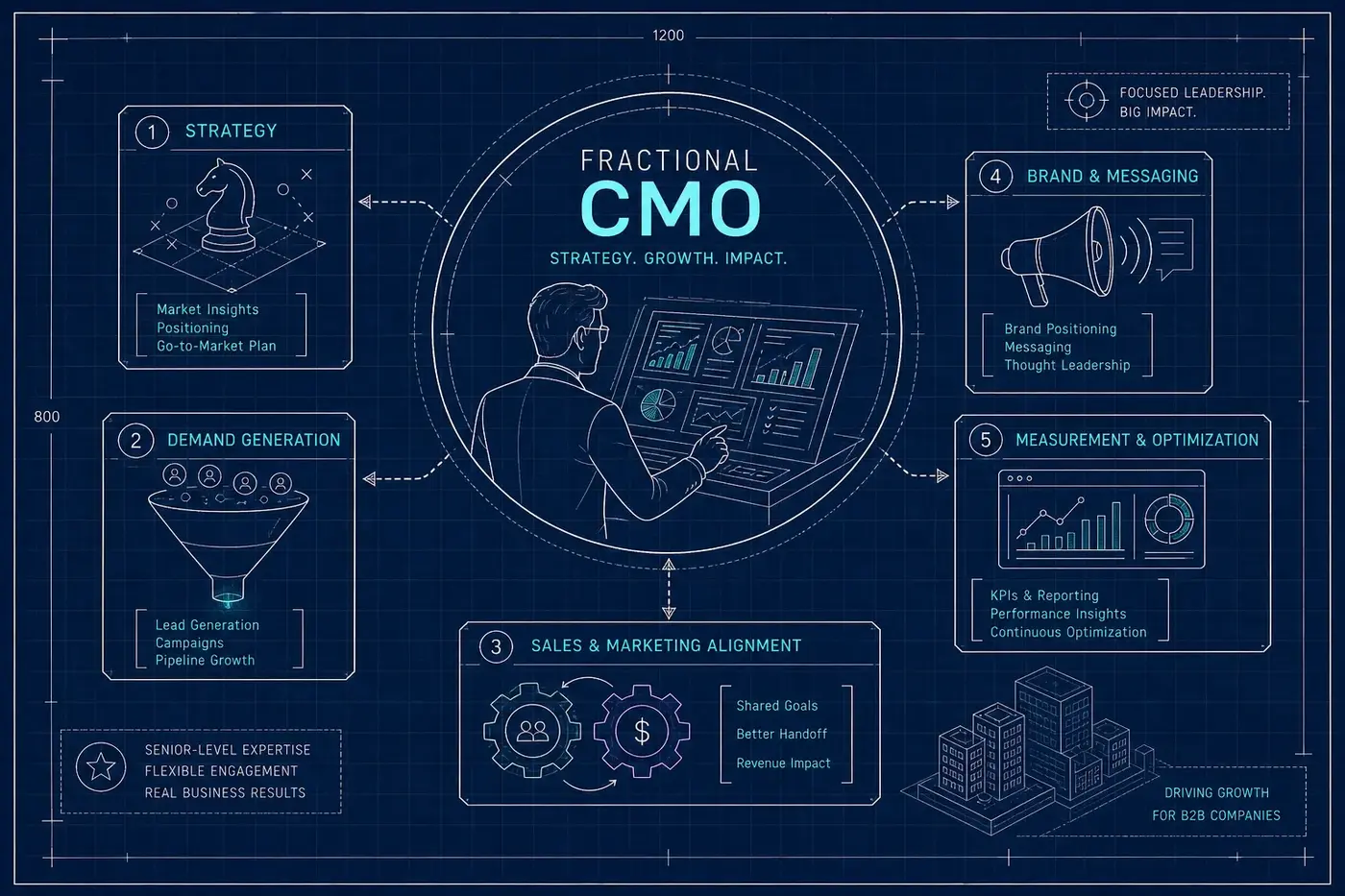
The fractional chief marketing officer role is an executive function, not a consultant arrangement. They own the go-to-market strategy: ICP definition, messaging hierarchy, and positioning, as well as the pipeline architecture and the demand generation engine that feeds it. They set the commercial direction and are accountable for it at board level, attending leadership meetings as a named voice on revenue performance.
Operationally, they manage week-to-week. That means overseeing the internal marketing team, managing agency relationships, approving campaign briefs, reviewing media spend, and adjusting priorities based on pipeline data. They lead quarterly business reviews with a commercial lens rather than presenting a marketing activity report. The critical distinction is accountability: a fractional CMO owns outcomes, not just recommendations. They plan and manage the marketing budget rather than advising on it from the outside.
What a fractional CMO doesn't do (and why the boundaries matter)
The most common mistake is treating an outsourced CMO like a permanent hire on a reduced schedule. They are not available for daily requests, ad hoc tasks, or reactive execution. They do not replace a marketing manager or a content producer. Their value comes from senior strategic oversight applied at defined intervals, typically four to eight days per month. Scope creep destroys that model quickly.
They also do not build dependency. A well-structured engagement builds the system, then transfers it. At the close of a well-run engagement, the internal team holds documented processes, live dashboards, and the capability to operate independently, rather than watching the capability walk out the door with the consultant. The RUTTENS+ Fractional CMO Embed builds this formally into every engagement: the handover stage is a defined phase with specific deliverables, not an afterthought. That structural commitment distinguishes it from models where the consultant retains all the institutional knowledge on exit, which remains frustratingly common.
Fractional CMO vs. interim CMO vs. marketing consultant
These three roles are frequently confused, and the confusion leads to expensive mismatches. An interim CMO is a full-time, temporary replacement. They fill a C-level gap during a resignation, restructure, or M&A integration where daily presence is non-negotiable. They manage the team directly, make all operational decisions, and hand over to the permanent hire. Engagements typically run three to twelve months with a clear end date. If your CMO resigned yesterday and you have a team of twelve waiting for direction, interim is what you need.
A marketing consultant works to a defined scope: an audit, a strategy document, or a campaign plan. They deliver recommendations and exit. They are accountable for the quality of the advice, not the commercial outcome. That is appropriate for a specific, bounded problem that does not require ongoing executive leadership.
A fractional CMO sits between both. They are a part-time executive, embedded in the leadership team on a recurring basis. They own strategy and outcomes, not just deliverables. Also described as a virtual CMO or contract CMO depending on the provider, the model suits businesses that need senior strategic leadership and execution ownership without the full-time cost. Most B2B SMEs in the £2M, £15M revenue range sit squarely in this category.
What a fractional CMO costs in the UK in 2026
Day rates in the UK currently run from £800 to £900 per day for structured retainer engagements, with the general market range sitting at £750 to £2,000 per day depending on experience and engagement complexity. Monthly retainers are the more common structure.
Typical retainer tiers by business stage
Early-stage or smaller businesses typically pay £3,000 to £6,000 per month. Scaling companies with revenues between £5M and £20M pay £8,000 to £15,000 per month. Complex or PE-backed organisations with multi-function oversight requirements often exceed £20,000 per month.
As a benchmark: a full-time UK CMO commands roughly £187,500 in base salary on average, with total compensation including bonus, pension, car allowance, and benefits reaching approximately £230,000 to £250,000 per year. A fractional engagement at the mid-market level represents roughly 25 to 45% of that cost. You are not buying a discounted full-time hire; you are buying senior strategic capacity on a model that fits your current revenue stage.
Typical engagement cadence and duration
The most common cadence for scaling SMEs is four to eight days per month, roughly one to two days per week. Early-stage businesses often start at two to four days per month. PE-backed or high-growth companies may run at eight to twelve or more days per month during intensive build phases. Engagements typically run six to eighteen months, with material commercial impact appearing from around month three rather than week one.
Which B2B companies get the most from a fractional CMO
The strongest fit is a UK B2B business with £2M to £15M in revenue where marketing exists but lacks strategic ownership. The team is running activity: some content, perhaps paid campaigns, a trade show or two. But the activity is disconnected from revenue targets, the ICP is vague, and the founder or CEO remains the primary commercial driver. That is the exact problem a senior fractional marketing director is designed to solve.
Common sectors include B2B SaaS, fintech, professional services, industrial SMEs modernising their go-to-market approach, and PE- or VC-backed scale-ups under investor pressure to systematise commercial functions. Investors increasingly use fractional CMO models across portfolio companies precisely because they deliver board-level marketing accountability without permanent headcount.
The model does not work in every situation. If there is no marketing budget, no CRM, and no internal capacity to execute, a fractional CMO has no infrastructure to lead, they need a foundation to build on, not a blank page with no resources. The engagement also breaks down if you want a part-time employee who attends every team meeting, responds to Slack within the hour, and handles daily requests. Those expectations describe a permanent hire, not a part-time CMO.
How to shortlist and hire the right fractional CMO
Before committing to any engagement, work through five key questions:
- Have they worked in your sector or with companies at your revenue stage?
- Can they show you a defined engagement model with clear deliverables, milestones, and an exit stage?
- How do they measure success, are KPIs tied to pipeline and revenue rather than marketing activity?
- What happens at the end of the engagement: do they leave a system the team can run, or does the capability leave with them?
- Are they personally delivering the work, or are they a front for a junior team?
That last question matters more than most buyers realise. Many providers sell senior leadership and deliver junior execution. The value is direct access to the leader responsible for the strategic decisions and the work they own. If that responsibility is filtered through multiple hand-offs, clarify who is accountable before you engage.
What a structured 90-day onboarding looks like
A structured 90-day onboarding. Weeks one to four should focus on a revenue audit, ICP validation, and pipeline gap diagnosis. Days thirty to sixty should see the GTM roadmap confirmed, early campaigns live, and team and agency alignment in place.
By days sixty to ninety, first pipeline data should be available, the measurement framework should be operational, and priorities should be adjusted based on evidence rather than assumption. Open-ended starts without defined milestones rarely produce commercial outcomes.
The commercial case, in plain terms
A fractional CMO is not a budget version of a full-time hire. It is a specific commercial model: senior strategic leadership and execution ownership on a flexible basis, designed for businesses at a revenue stage where full-time cost is not yet justified but continued founder dependence is no longer sustainable. For UK B2B companies in that window, it is one of the most cost-effective ways to build a repeatable pipeline engine without waiting six months for a permanent hire to ramp.
Bring the current commercial question to a conversation. The next step depends on the situation.