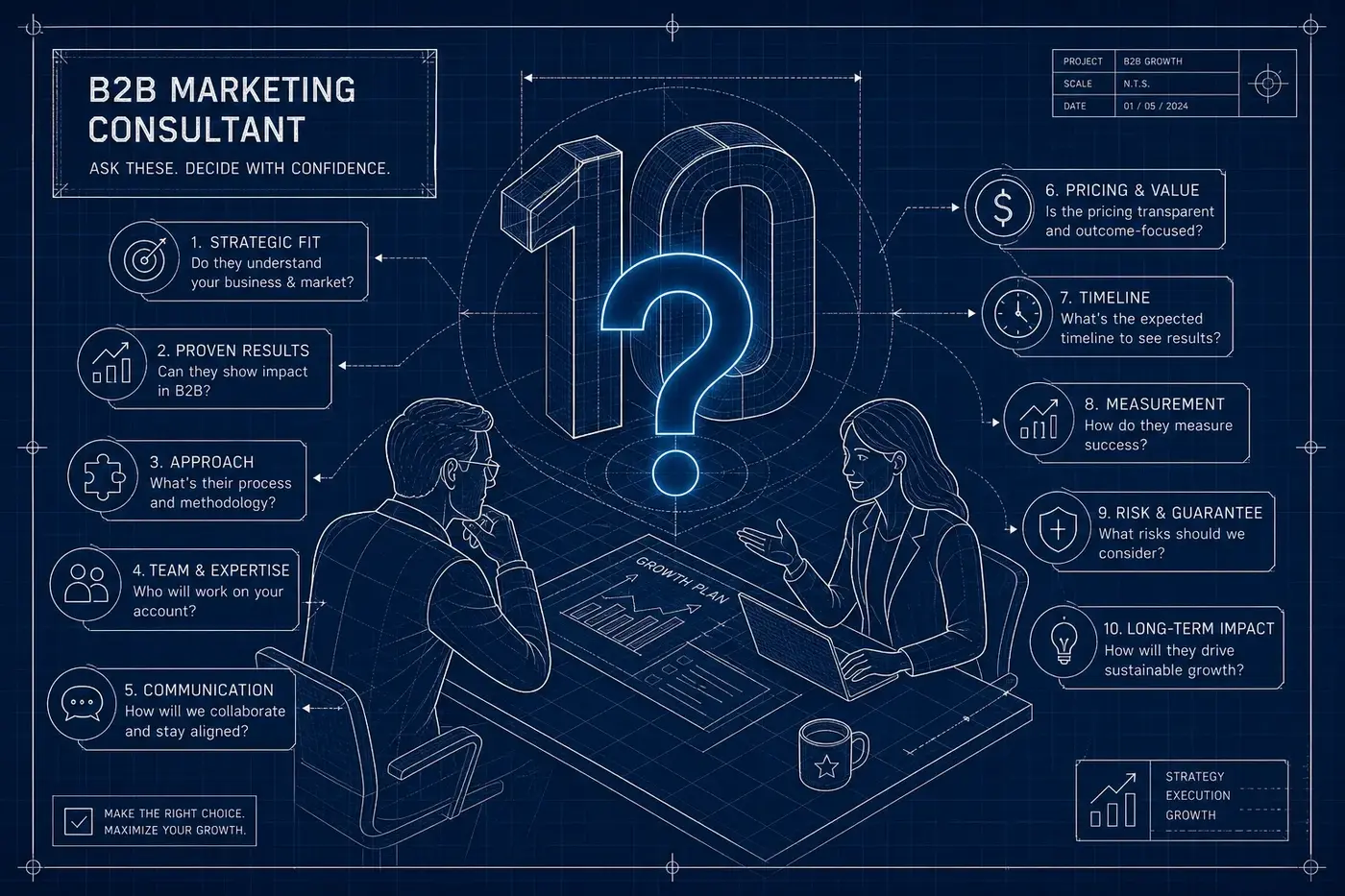
B2B marketing consultant: 10 questions before you sign
Hiring a B2B marketing consultant in the UK is rarely the difficult part. Every candidate arrives with a polished deck, a credible client logo, and a confident pitch. The real problem is knowing which questions will separate a genuinely strategic operator from someone who spends six months producing activity reports that never move your pipeline. Many firms operate in this space, and the market is noisy enough that a persuasive presentation can easily mask a shallow methodology. Getting this wrong costs you time, budget, and, in founder-led businesses, months of opportunity cost you cannot recover.
a 10-question checklist covering three dimensions: strategic depth, execution capability, and what accountability actually looks like when the engagement ends. Our audits of B2B leaders frequently surface the same recurring diagnostic gaps, and those patterns directly inform the questions below. Use them before you sign anything.
What a B2B marketing consultant actually does (and what most don't)
There is a fundamental difference between a consultant who diagnoses your commercial system and a supplier who executes channel tactics. Most buyers conflate the two, and the result is paying senior-level day rates for junior-level output. A genuine B2B marketing strategy consultant should offer ICP definition, messaging architecture, demand generation design, sales and marketing alignment, and RevOps measurement. Whether you are evaluating a freelance B2B marketing specialist, a B2B marketing agency, or a fractional CMO, if the proposal leads with content calendars and LinkedIn posting schedules, you are looking at a tactician with a consultant's job title.
The services a consultant offers should also reflect your growth stage. A seed-stage founder who has been closing deals personally through relationships needs entirely different inputs than a Series B CMO building pipeline velocity at scale, or an industrial SME MD modernising a trade-show-and-brochure marketing function. A consultant who offers the same service package to every client is not diagnosing your situation; they are selling a product. a structured framework that covers targeting, pipeline architecture, conversion, measurement, and, critically, a defined handover stage. That last element is what separates a genuine consulting engagement from an indefinite agency retainer that runs until someone gets tired of paying for it.
Pricing models and what you should expect to pay in the UK
UK mid-level B2B marketing consultants typically charge between £300 and £600 per day. Senior strategists run from £700 to £1,500 or more, with London rates averaging around £603 per day compared to £426 to £447 in Birmingham or Manchester. Experience matters significantly: consultants with fewer than two years of experience average around £354 per day, while those with 15 or more years average closer to £904. These figures reflect current market-rate benchmarks and will vary by specialism, sector, and scope. Fractional CMO retainers typically sit between £4,000 and £12,000 per month depending on scope and seniority, and project-based engagements for defined problems, such as positioning or launch strategy, usually range from £8,000 to £40,000.
What a B2B marketing consultant's pricing model tells you is as revealing as the rate itself. A consultant who quotes a monthly retainer without first diagnosing your pipeline is selling you time, not outcomes. The structure to look for is a phased engagement with defined deliverables at each stage: a discovery and diagnosis phase, a build phase, and a handover phase with a clear exit state. An indefinite retainer with vague scope does the opposite, it protects the consultant's revenue stream and gives them no incentive to resolve your problem quickly. This distinction is one of the most reliable filters before you even get to an interview.
For additional context on market pricing and fee benchmarks, see analyses of how much B2B marketing consulting costs and surveys of marketing consultant hourly rates.
Questions 1, 5: testing strategic depth and revenue clarity
Q1: "What is your diagnostic process before you recommend anything?" A consultant who cannot describe a structured discovery methodology before proposing solutions is skipping the most important step in the entire engagement. If the answer is "we start with a kick-off call and build a plan from there," that is not a diagnostic process; it is a polite way of saying they will reverse-engineer a proposal around whatever you tell them you want.
Q2: "What questions will you ask me in the first meeting?" Strong candidates ask about revenue targets, current pipeline sources, average sales cycle length, and customer acquisition cost before they mention a single tactic. If they go straight to services, channels, or their own case studies, that is a red flag. The quality of a consultant's questions reveals far more about their capability than their case studies ever will.
Q3: "How do you define and validate an ideal customer profile?" Vague answers such as "we look at firmographics and company size" indicate surface-level thinking. Strong consultants describe a process involving buyer interviews, pipeline data analysis, and win-loss patterns. The ICP is the foundation everything else is built on; if the methodology for building it is weak, the targeting, messaging, and campaigns that follow will be too.
Q4: "Can you show me a messaging framework you have built for a similar business?" They should be able to walk you through the architecture and the reasoning behind it, not just point you to a landing page or a brand guidelines document. If they cannot explain how they arrived at the positioning, they probably inherited someone else's work or templated it from a previous client.
Q5: "Have you worked in our sector, and what was the specific outcome?" Push beyond logos and PDF case studies. Ask for pipeline contribution numbers, MQL-to-SQL conversion rates, or cost-per-MQL comparisons before and after the engagement. Then ask who in their team actually delivered the work, because the answer to that question leads directly into the next set of questions.
Questions 6, 10: execution capability and accountability structures
Q6: "Who specifically will be working on our account day to day?" This is where the pitch-and-switch happens most often. Junior-heavy consultancies sell senior strategy in the room and then hand the account to a graduate-level team member once the contract is signed. Confirm the seniority of the individuals who will actually be writing the briefs and making the strategic calls throughout the engagement, not just the ones who appeared in the pitch.
Q7: "What does your team structure look like, and what is the ratio of full-time staff to freelancers?" High freelancer dependency creates continuity risk in a six-month engagement. Freelancers rotate; context gets lost; your account manager changes. Stability matters, particularly if the work involves building systems and playbooks that require consistent institutional knowledge of your business.
Q8: "What marketing technology do you work with, and what do you expect us to have in place?" This question surfaces whether the consultant can execute within your existing stack or whether they will generate a lengthy and expensive tool implementation list before a single campaign goes live. A senior operator adapts to the tools you already have. A consultant who cannot begin without a specific CRM, automation platform, or attribution tool is optimising for their own workflow rather than your constraints.
Q9: "How will you define and measure success in the first 90 days?" Legitimate answers focus on pipeline contribution, MQL-to-SQL conversion rates, cost per MQL, and pipeline velocity. Vague answers about brand awareness or social engagement without any linkage to pipeline should concern you. In the first three months, the job is to confirm that targeting and messaging are calibrated correctly before you scale spend. Closed-won revenue is not a realistic primary KPI at this stage in most B2B sectors. Any consultant who promises it without first understanding your average sales cycle length is misrepresenting the timeline.
Q10: "What does the end of our engagement look like, and what will our team be able to do independently?" This is the most important question on the list. A consultant who cannot describe a clear handover, including documented playbooks, trained team members, and systems your people own and operate, is building dependency, not capability. Handover is a frequently reported failure point in consulting engagements: when it is handled poorly, pipeline momentum drops the moment external support leaves. At RUTTENS+, the Handover stage is a defined deliverable built into every engagement from day one, because without it the work simply disappears when the consultant does.
How a B2B marketing consultant should measure success: KPIs at 3 and 6 months
In the first 90 days, the focus should sit on funnel efficiency metrics: MQL volume, cost per MQL, visitor-to-lead conversion rates, and an initial MQL-to-SQL baseline. These confirm that targeting and messaging are calibrated correctly before you scale spend. For context, industry estimates for 2026 suggest B2B SaaS companies benchmark MQL-to-SQL conversion at between 32% and 45% for average performers, with top performers reaching 60% or more. Professional services firms sit around 42%. Note that MQL definitions vary significantly between organisations, so treat these as directional benchmarks rather than absolute targets. If your baseline is below 20%, that signals a structural issue with lead scoring or ICP definition that needs resolving before you increase lead volume.
By months four to six, the focus should shift to pipeline contribution percentage, opportunities created, and pipeline velocity. These are the leading indicators that predict revenue three to six months further out. A functional attribution model should also be in place by this point: a system that links campaigns to pipeline so your team can make informed budget decisions going forward. If a consultancy cannot show you this infrastructure at month six, the engagement has not delivered what it should. The attribution model is not a nice-to-have; it underpins most future budget conversations you will have with your board.
De-risk the engagement before you sign a retainer
Most buyers jump straight to a six-month retainer based on a proposal document and a confident pitch. That is the fastest route to a frustrating experience. The alternative is a structured, bounded first engagement designed to prove strategic value before any larger commitment is made. A diagnostic first step should identify your top pipeline gaps, the first lever to pull, and whether the consultant's thinking genuinely applies to your commercial situation. If they cannot do that in a defined, deliverable format, the full retainer will not go better.
Bring the current commercial question to a conversation. The next step depends on the situation.
Use these questions before you spend a pound
A B2B marketing consultant is one of the highest-leverage hires a leadership team can make, and one of the easiest to get wrong. The 10 questions in this guide are designed to separate strategic depth from polished pitching, and to surface the red flags that experienced buyers typically learn to recognise only after an expensive mistake.
The three evaluation dimensions are straightforward. First: does the consultant diagnose before recommending, or do they go straight to a service menu? Second: can they execute at a senior level without bait-and-switch staffing once the contract is signed? Third: do they build your team's capability, or protect their own dependency? A strong candidate, whether a B2B demand generation consultant, a marketing consultant for professional services, or a fractional CMO, answers all three confidently and with specifics.
Take these questions into your next conversation with a potential consultant. If the answers are vague, the engagement will be too. And if you want to test strategic fit before committing to a retainer, start with a bounded diagnosis first. The cost of getting this decision wrong is far higher than the cost of taking an extra two weeks to get it right.