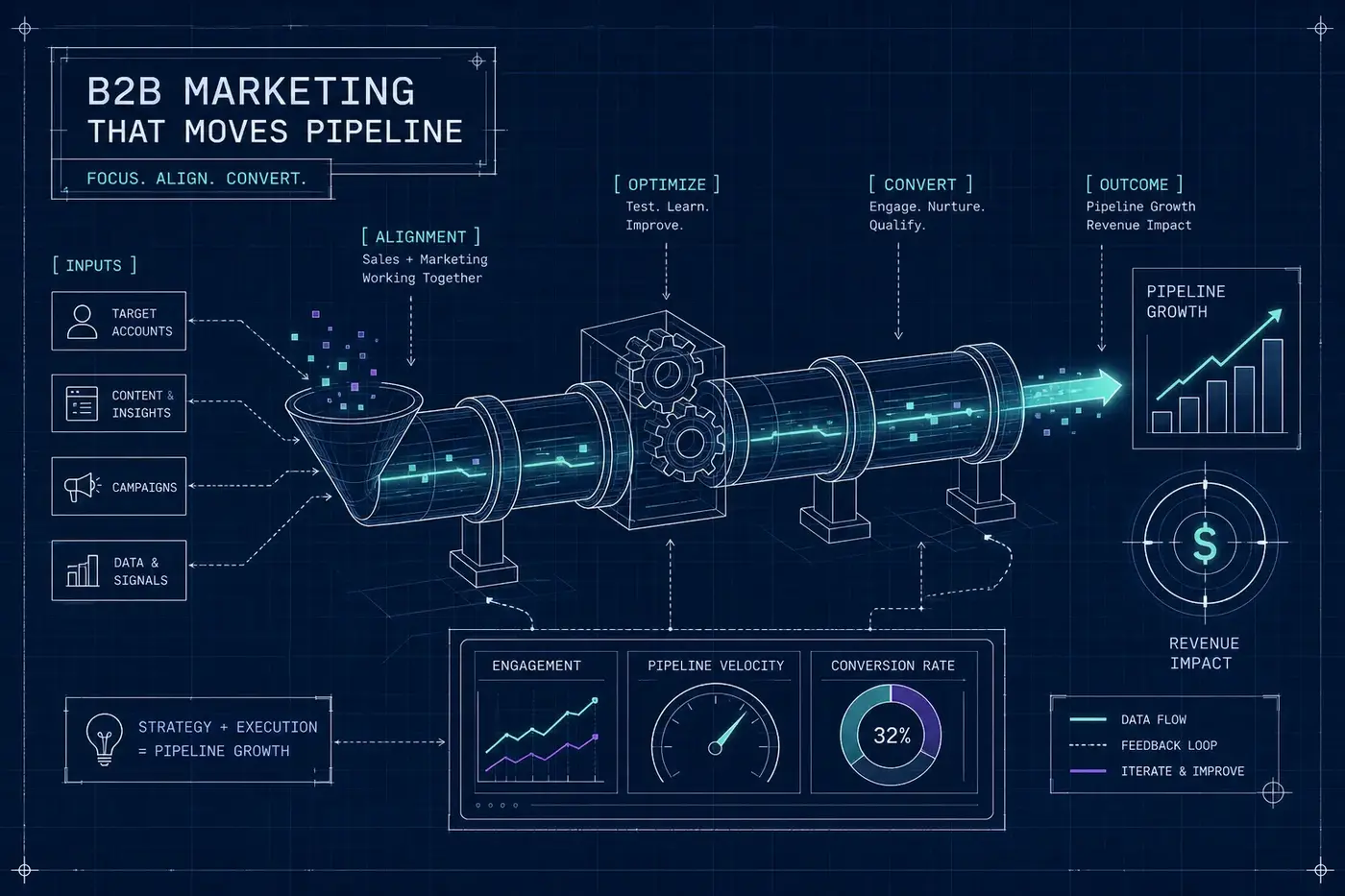
Most B2B marketing budgets are producing activity, not pipeline. Teams are publishing content, running LinkedIn campaigns, sending nurture sequences, and generating MQLs. The dashboards look respectable. The sales team isn't closing. If that tension feels familiar, you're not dealing with a channel problem or a creative problem. You're dealing with a system problem.
Bring the current commercial question to a conversation. The next step depends on the situation.
This article covers the five things that actually move pipeline in 2026: diagnosing why most B2B marketing fails, building ICP clarity, running effective demand generation, aligning marketing with what sales closes, and measuring the right metrics. It closes with a 90-day framework you can implement immediately.
Why most B2B marketing activity doesn't move pipeline
The gap between marketing effort and pipeline outcomes is not a mystery. It has a consistent cause: activity is optimised for activity, not for revenue. Three failure patterns drive almost every underperforming GTM system in business-to-business marketing.
The activity trap: confusing output with outcomes
Marketing output includes posts published, emails sent, MQLs generated, and cost-per-lead achieved. Pipeline outcomes are qualified opportunities created and revenue influenced. These are not the same thing, and optimising for the former while expecting the latter is how companies end up with strong marketing dashboards and empty pipelines.
A common example: a SaaS company runs LinkedIn ads with a cost-per-lead that looks efficient by industry benchmarks. The sales team rejects the majority of leads, rejection rates of 70–85% are not uncommon, as unqualified. A leading root cause is typically the absence of a shared ICP definition. Marketing targets based on job title. Sales qualifies against a completely different set of criteria that was never written down.
The missing link between marketing and revenue
Marketing-to-sales misalignment is not a people problem. It is a structural problem that emerges when two functions measure success against different targets. When marketing measures MQL volume and sales measures closed revenue, they optimise against each other without realising it. The 2026 shift among high-performing B2B demand generation teams is meaningful here: 58% now use pipeline-weighted scoring as their primary metric, and moving away from MQL volume as the primary measure lifts pipeline-to-revenue conversion by 19%.
What a working B2B marketing system looks like
A revenue-aligned GTM system connects targeting, messaging, pipeline architecture, and measurement into a single engine. Each component depends on the others. Targeting without measurement tells you nothing. Messaging without ICP clarity talks to nobody. The framework used throughout this article is drawn from the commercial clarity approach methodology, a proprietary RUTTENS+ model built around five stages: Target, Attract, Convert, Measure, and Handover. The cylinders are activated in sequence, and only the ones relevant to the company's growth stage are prioritised. What follows is that sequence applied to B2B marketing in 2026.
ICP clarity: the foundation everything else sits on
Most effective go-to-market strategies depend on a precise ideal customer profile, not because it's a best-practice checkbox, but because every downstream decision flows from it: channel selection, messaging, content, and sales qualification criteria alike. Without ICP clarity, you're spending on targeting that converts nobody worth closing.
What a strong ICP actually contains
A working ICP includes firmographic criteria (industry, company size, revenue range, headcount) and situational triggers (growth stage, recent funding, technology stack, organisational change). It also needs behavioural signals, content consumption patterns, event attendance, search intent, together with the economic buyer profile: title, primary priorities, and typical objections. High-performing B2B companies validate these criteria against actual customer data, using metrics like annual contract value, retention rate, and net promoter score to identify which account characteristics define their best customers.
The distinction between a real ICP and a vague persona document that collects dust in a shared drive is specificity. "VP of Sales at a SaaS company" is not an ICP. "VP of Sales at a Series A SaaS company with 50–150 employees, a CRM that isn't integrated with their marketing stack, and a sales team of five or more who are closing deals manually" is the beginning of one.
How ICP clarity changes every downstream decision
Once the ICP is confirmed, channel selection becomes logical rather than speculative. LinkedIn organic and paid content for enterprise SaaS targeting VP-level buyers. Trade press and direct outreach for industrial SMEs where buyers don't live on social platforms. Messaging becomes precise because you know what the economic buyer cares about at each stage of their journey. Content topics align to actual buyer pain rather than SEO topics the marketing team found interesting.
The MQL rejection problem largely resolves itself. Industry data consistently identifies ICP failures as the primary driver of sales rejections: company size mismatch, insufficient budget authority, and wrong-industry targeting account for the bulk of rejected MQLs across B2B pipelines. When the ICP is defined, agreed upon by both marketing and sales, and embedded into CRM scoring criteria, handoff quality improves immediately. Fewer, higher-quality MQLs with a strong sales-acceptance rate will outperform a high volume of low-quality leads by every meaningful revenue metric.
B2B lead generation: channels that convert in 2026
Channel hype cycles quickly in B2B. The channels worth investing in for 2026 are the ones generating qualified pipeline at a defensible cost, not the ones generating the most impressions or the most social commentary.
The channels worth prioritising and why
Intent-based SEO delivers the lowest long-term cost per acquisition for B2B companies that execute against buyer-intent patterns rather than vanity keywords. It compounds over time in a way that paid channels don't.
Account-based marketing is delivering the strongest retention and upsell ROI of any strategy: 85% of marketers report improved retention, and 93% of SaaS marketers rate it as highly effective. Webinar-led paid campaigns are among the most measurable B2B lead generation channels available, with cost-per-close and average contract values that make the economics straightforward to evaluate, though figures vary by sector, deal complexity, and region, so benchmarking against your own data is essential.
LinkedIn remains essential for building professional authority in complex verticals where the buying committee is active on the platform. Video marketing has moved from campaign add-on to primary content medium, effective across both awareness and conversion stages of the funnel.
Account-based marketing: how to implement it without enterprise resources
ABM is accessible to mid-market B2B companies when scoped correctly. Align sales and marketing on account criteria, build a curated target list of 10–20 accounts to start, map the decision-making committee within each account, develop messaging that addresses their specific situation, and run multi-channel engagement across email, LinkedIn, and direct outreach. The critical sequencing point: do not invest in ABM software until the process is proven at small scale. Software investment amplifies a working process. It doesn't create one.
B2B marketing automation and AI: what's actually changing demand generation
Nearly 90% of B2B buyers now use generative AI during purchase research (per Forrester's 2026 B2B Buying Study), and buyers complete up to 69% of their journey anonymously before contacting sales. The practical implication for demand generation is significant.
Content must be structured for AI retrieval, not just search engine indexing. Answer Engine Optimisation is no longer optional for companies that want visibility during the buyer's self-directed research phase. Intent signal tracking, where the majority of high-performing teams now run always-on plays triggered by third-party intent data, has become a core operational capability rather than an advanced tactic. Companies implementing AI-first demand generation playbooks systematically are reporting meaningful reductions in customer acquisition costs in year one, though outcomes vary by sector and implementation maturity.
Revenue alignment: connecting marketing to what sales actually closes
The best demand generation system in the world fails if the leads it produces don't convert when they reach sales. Revenue alignment is the structural work that makes the marketing-to-sales handoff function as a system rather than a handoff in name only.
Fixing the handoff between marketing and sales
A functional lead handoff requires three things: a shared Sales Accepted Lead (SAL) definition that both teams have agreed to and documented; a clear handoff process covering CRM stage update, immediate notification, and context transfer on the lead's behaviour and intent; and a measurement mechanism that tracks SAL-to-opportunity conversion rate so lead quality can be evaluated, not just volume. When these three elements are in place, the conversation between marketing and sales stops being about lead quality in the abstract and starts being grounded in data, which stage is leaking, why, and what changed.
The RevOps basics every B2B marketing team needs
The minimum viable RevOps setup for a growth-stage B2B company is simpler than most teams assume. It requires clean CRM data with agreed lifecycle stage definitions, CAC and LTV tracking by channel and segment, a pipeline attribution model that credits marketing touches across the full buyer journey, and a single dashboard that both marketing and sales leadership review in the same weekly meeting. The barrier is rarely technology. Platforms such as HubSpot's Marketing Hub Pro cover most of this functionality, check current regional pricing directly, as costs vary by market and are updated regularly. The real barrier is the absence of shared definitions and a single accountable owner for the revenue measurement system.
The metrics that tell you whether your B2B marketing is working
Measuring B2B marketing ROI requires a clear hierarchy. Most teams measure the wrong things with precision and ignore the metrics that actually tell them whether the system is working.
Pipeline metrics over activity metrics
The metrics that matter are pipeline generated, pipeline influenced, pipeline-to-revenue conversion rate, and CAC by channel. MQL volume, social impressions, and email open rates are diagnostic signals, they help you understand why pipeline metrics are moving in a particular direction. They are not the primary KPIs. This distinction is the difference between a marketing team that optimises for its own comfort and one that optimises for revenue outcomes.
Conversion benchmarks to calibrate against
The funnel-stage benchmarks from 2026 research provide useful diagnostic references. Visitor-to-lead conversion averages 2–5% (top performers at 3.5%+). Lead-to-MQL runs at 20–40%. MQL-to-SQL at 13–35%. SQL-to-opportunity at 30–62%. Opportunity-to-won at 15–35%. If your numbers are significantly below these at any specific stage, that stage is where your pipeline is leaking, and it requires attention before you consider increasing marketing spend. More spend into a leaking pipeline produces more leakage, not more revenue.
A 90-day B2B marketing framework to put this into practice
The most common mistake B2B companies make when trying to fix their pipeline is jumping straight to channel execution. They run ads. They publish content. They hire a fractional resource to manage LinkedIn. None of it compounds because the underlying system is not in place to convert what the channels generate.
The sequencing that matters: why most companies start in the wrong place
The correct sequence is: diagnose current pipeline gaps, confirm ICP, define messaging by segment, build measurement infrastructure, then activate channels. This is the same sequencing used in the RUTTENS+ 90-Day Pipeline Build, always. Channel activation without ICP clarity produces unqualified leads. Unqualified leads produce a rejected handoff. A rejected handoff produces a conversation about sales and marketing alignment that consumes months without resolution.
What the first 30, 60, and 90 days look like
Days 1–30 are diagnostic and foundational. Audit current pipeline health, confirm the ICP definition with input from sales, align marketing and sales on lead criteria and handoff process, and establish baseline metrics in the CRM. Nothing is activated yet. This phase exists to ensure that everything activated next has somewhere coherent to land.
Days 31–60 shift to activation and testing. Launch two to three priority channels based on confirmed ICP and buyer behaviour data. Build initial content assets aligned to buyer intent at each funnel stage. Launch an ABM pilot with 10–15 target accounts. The emphasis is on validating what works before committing spend to what hasn't yet proved itself.
Days 61–90 focus on optimisation and handover. Review pipeline-weighted metrics against the baselines established in month one. Optimise underperforming channels based on SAL conversion data rather than impression or click data. Tighten the handoff process where the data shows it's leaking. Document the system so the internal team can own and operate it independently when the engagement closes.
Bring the current commercial question to a conversation. The next step depends on the situation.
The bottom line on B2B marketing in 2026
B2B marketing in 2026 is a system design problem, not a channel selection problem. The companies generating consistent, predictable pipeline have made deliberate choices about ICP, demand generation, and revenue alignment before spending on execution. They measure pipeline outcomes rather than activity outputs. They fix the handoff before they scale the top of the funnel.
Bring the current commercial question to a conversation. The next step depends on the situation.
Bring the current commercial question to a conversation. The next step depends on the situation.