AI GTM: Why It's Replacing Traditional Go-to-Market in B2B
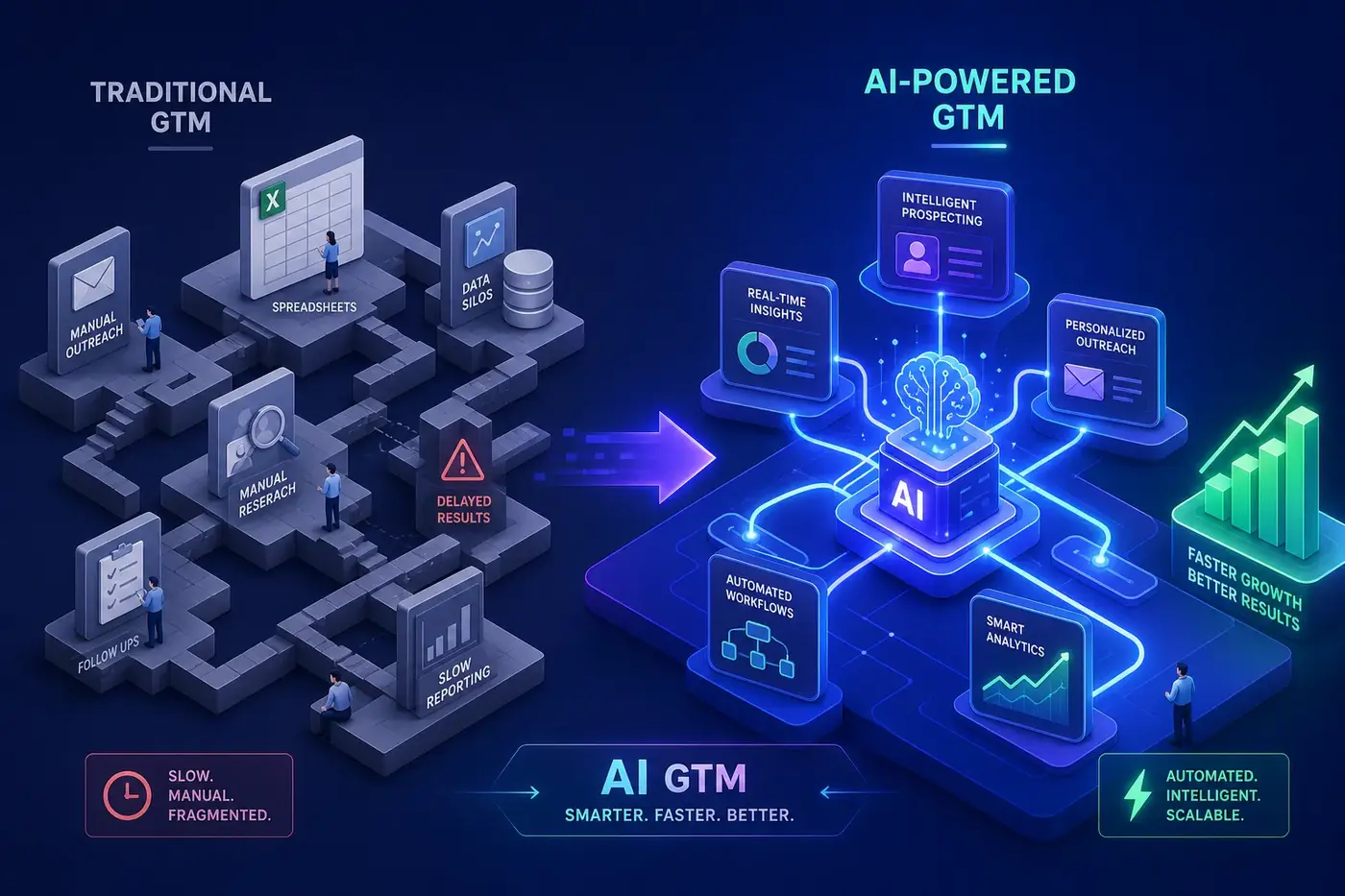
Traditional go-to-market was designed for a buyer who no longer exists. AI GTM approaches exist precisely because that old model has broken down. The buyer it was built for responded to cold sequences, clicked on gated content, and raised a hand before forming a settled view. Today's B2B buyers complete 60 to 70 per cent of their decision journey before they speak to a salesperson, a figure consistently cited across multiple buyer behaviour studies, though the precise range varies by sector and deal complexity. Campaigns built on assumptions, sequences running on static lists, and founders closing every significant deal personally are not symptoms of bad execution. They are symptoms of a structural mismatch between the GTM model and the market it is trying to serve.
AI-augmented go-to-market, what practitioners now call AI GTM, is the architectural response to that mismatch. It is not a tool category or a feature set. It is a different way of building and operating a revenue system: one that connects real-time buyer signals, automated decision logic, and multi-channel execution into a continuously improving pipeline engine. The shift is no longer experimental. Eurostat data (2025) shows roughly 20 per cent of EU enterprises used AI that year, and among those, over a third applied it specifically to marketing and sales.
At RUTTENS+, embedding AI into client go-to-market systems since before the category had a formal name, working with B2B companies across Europe to replace volume-based motions with signal-driven revenue architecture. This article defines what AI GTM means as a category, explains how it changes both strategy and execution, maps the main platform categories, and gives a practical 90-day starting point for B2B leadership teams ready to make the same shift. What follows is operational insight from building these systems, not vendor marketing.
What AI GTM actually means (and what it doesn't)
Most definitions collapse into "using AI tools in your sales and marketing process." That framing misses the point, and it leads teams to buy tools without changing the underlying system. It is why so many AI investments produce marginal results and generate scepticism inside leadership teams that should know better.
Beyond marketing automation: why the system matters more than the software
Legacy marketing automation follows instructions. If a contact opens an email, trigger the next step. If a lead scores above 50, route to sales. The logic is linear, rule-based, and static. AI-augmented GTM interprets signals, adjusts in real time, and routes the right action to the right channel without manual intervention. A contact browsing your pricing page late at night while changing jobs does not need the next email in a sequence. It needs a different kind of response entirely, and a well-built AI GTM system can recognise that and act on it automatically.
The three layers every reliable AI GTM system needs
The architecture has three distinct layers, and a gap in any one of them can materially weaken outcomes across the whole system. The first is the data and signals layer: intent data, enrichment, web behaviour, job-change triggers, and buying-group activity. The second is the orchestration layer: the routing logic, prioritisation rules, and workflow decisions that determine what happens with those signals. The third is the execution layer: the outreach, content delivery, conversation tools, and pipeline tracking that carry the signal-to-action loop through to revenue. Buying a platform that addresses only one layer is the most common and costly mistake in this space.
Why traditional go-to-market is breaking down in B2B
Traditional GTM was built on a volume assumption: enough calls, enough emails, enough spend, and the pipeline fills. That model is straining against a buyer population that moves through most of its decision process before it surfaces in a CRM. By the time a lead appears in a sequence, the window for influence may already be narrow.
The signals problem: your pipeline cannot predict itself
Most B2B revenue teams are operating on lagging indicators. CRM data entered after conversations, attribution models that credit the last click, pipeline forecasts built on gut feel and rep optimism. These inputs generate a report, not a system. AI GTM replaces lagging indicators with leading signals: intent data, dark-social engagement, job-change triggers, and buying-group activity that surfaces demand before an account self-identifies. ZoomInfo's Go-to-Market Intelligence Report found that GTM professionals using AI at least weekly save an average of twelve hours per week, not because AI does all the work, but because it removes the manual effort of hunting for signals that a well-built system should surface automatically.
Human capacity versus modern buyer expectations
Modern B2B buyers expect relevant, timely, personalised engagement across multiple channels simultaneously. A human SDR team, however skilled, cannot deliver that at scale without a system underneath it. Founder-led sales compounds the problem significantly. When the quality of the commercial motion depends entirely on one person's bandwidth, the ceiling on growth is not the market, it is the calendar. GTM automation with AI breaks that constraint structurally, which is why it is particularly valuable for founder-led and early-growth B2B companies looking to build a repeatable pipeline without adding headcount at every stage. Pilot data from RUTTENS+ client engagements in time-per-qualified-opportunity once signal routing replaces manual prospecting.
How AI augments GTM strategy and execution in practice
AI does not generate strategy. It amplifies the strategy you already have. Many B2B leaders buy AI tools expecting autonomous output, then lose confidence when the results reflect a vague ICP or an untested value proposition. The quality of an AI GTM system is a direct function of the quality of the thinking behind it.
From ICP definition to pipeline architecture
AI changes specific GTM decisions in ways that compound quickly. It enriches ICP data with behavioural and firmographic signals rather than relying on static definitions built from historical guesswork. It stress-tests messaging against real intent patterns. It sequences multi-channel plays based on buying-group stage rather than calendar logic. At RUTTENS+, the commercial clarity approach framework, Target, Attract, Convert, Measure, Handover, to identify which layer to activate first, because not every company has the same gap, and deploying AI into the wrong layer produces activity rather than pipeline.
The metrics that shift when AI enters the stack
The published outcome data is directional but consistent across multiple vendor-published studies and industry benchmarks. Companies using AI in GTM workflows report approximately 40 per cent faster market entry and 35 to 37 per cent higher conversion rates through the sales funnel (sources include Genesys Growth and comparable GTM benchmark research). AI-powered ICP scoring can reduce false positives by 35 to 55 per cent compared with firmographic-only filtering, and predictive scoring raises sales acceptance rates by up to 35 per cent compared with rules-based systems, ranges drawn from vendor-reported data that should be treated as directional rather than guaranteed. The pipeline KPIs that matter most are MQL-to-SQL conversion, pipeline velocity, win rate, and CAC. These are the numbers that tell you whether the AI GTM system is working or simply generating activity.
The main AI GTM platform categories and how to evaluate them
The market has fragmented into at least five distinct platform categories, each solving a different part of the system. Buying a platform before diagnosing which layer is broken is the single most expensive implementation error B2B teams make, and it is almost always driven by a vendor demo rather than a revenue audit.
Five categories, five different problems
The landscape of GTM AI platforms currently spans the following categories, each purpose-built for a specific function:
- Autonomous outbound agents, platforms such as Artisan and 11x.ai run the SDR function end to end, covering sourcing, research, outreach, and meeting booking, though governance and quality control remain important considerations when deploying these tools at scale.
- Enrichment and orchestration platforms, most notably Clay, which builds the data workflows that feed the system, connecting 150-plus enrichment providers with configurable workflow logic (per Clay's published documentation).
- AI-powered ABM tools, platforms such as 6sense and Demandbase serve enterprise account-based motions, using predictive analytics and buying-group intelligence to surface in-market accounts before they engage.
- CRM-native AI, including HubSpot Breeze and Salesforce Agentforce, delivering agentic AI for sales within the existing system of record for teams who want to avoid adding another platform to an already complex stack.
- Revenue intelligence tools, such as Gong and Clari, handling pipeline visibility, call analysis, and forecasting accuracy.
Each category is useful. None of them is a complete system on its own.
What to evaluate beyond the feature list
For mid-market and scale-up B2B teams, the practical evaluation criteria are: native CRM and marketing automation integrations that are bidirectional rather than CSV-based, data quality and signal reliability, and total cost of ownership. Mid-market stacks typically run between £12,000 and £60,000 per year across two or three tools, broadly equivalent to the $15,000, $75,000 USD ranges cited in US market research, converted at approximate current rates, with implementation timelines ranging from a few weeks for simpler tooling to three months for a more integrated build. The most useful question to ask a vendor is not "what can your platform do?" but "which specific pipeline problem does it solve, and how do you measure that?" If the answer is vague, that tells you something important before you commit a penny.
Your first 90 days: a practical AI GTM starter plan
The most expensive AI GTM mistake is buying before diagnosing. The first priority is not selecting a platform. It is identifying the specific pipeline gap that AI needs to close. Without that clarity, teams deploy tools into a broken system and attribute the failure to the technology rather than the architecture underneath it.
Weeks 1 to 4: diagnose before you buy, starting with an AI GTM audit
Bring the current commercial question to a conversation. The next step depends on the situation.
Weeks 5 to 12: pilot one workflow, measure it, then expand
Select one high-impact workflow and run it properly. For mid-market B2B teams, the three most common starting points are:
- Signal-triggered outreach: using intent or job-change data to route timely, relevant contact to in-market accounts.
- ICP enrichment: rebuilding your target account list with behavioural and firmographic data to reduce wasted prospecting effort.
- Pipeline reporting: replacing gut-feel forecasts with a clean, usable dashboard that gives leadership a reliable view of velocity and risk.
Instrument the workflow before launch, not after. Define your success metrics upfront, reply rate, MQL-to-SQL conversion, time saved per week, and commit to a six-week data cycle before drawing conclusions. Expansion comes from proof, not enthusiasm. Teams that attempt to transform too many GTM functions simultaneously tend to underinvest in each one and produce evidence from none of them.
Architecture first, tools second
AI GTM is not a trend to monitor or a tool category to evaluate at your next budget cycle. It is a fundamental shift in how B2B revenue systems are designed, operated, and owned. Companies that treat it as an add-on to their existing motion will see marginal gains. Companies that redesign the architecture will build a pipeline that runs without the founder at the centre of every deal, without sequences that go cold when an SDR leaves, and without a forecast that depends on memory rather than data.
Bring the current commercial question to a conversation. The next step depends on the situation.