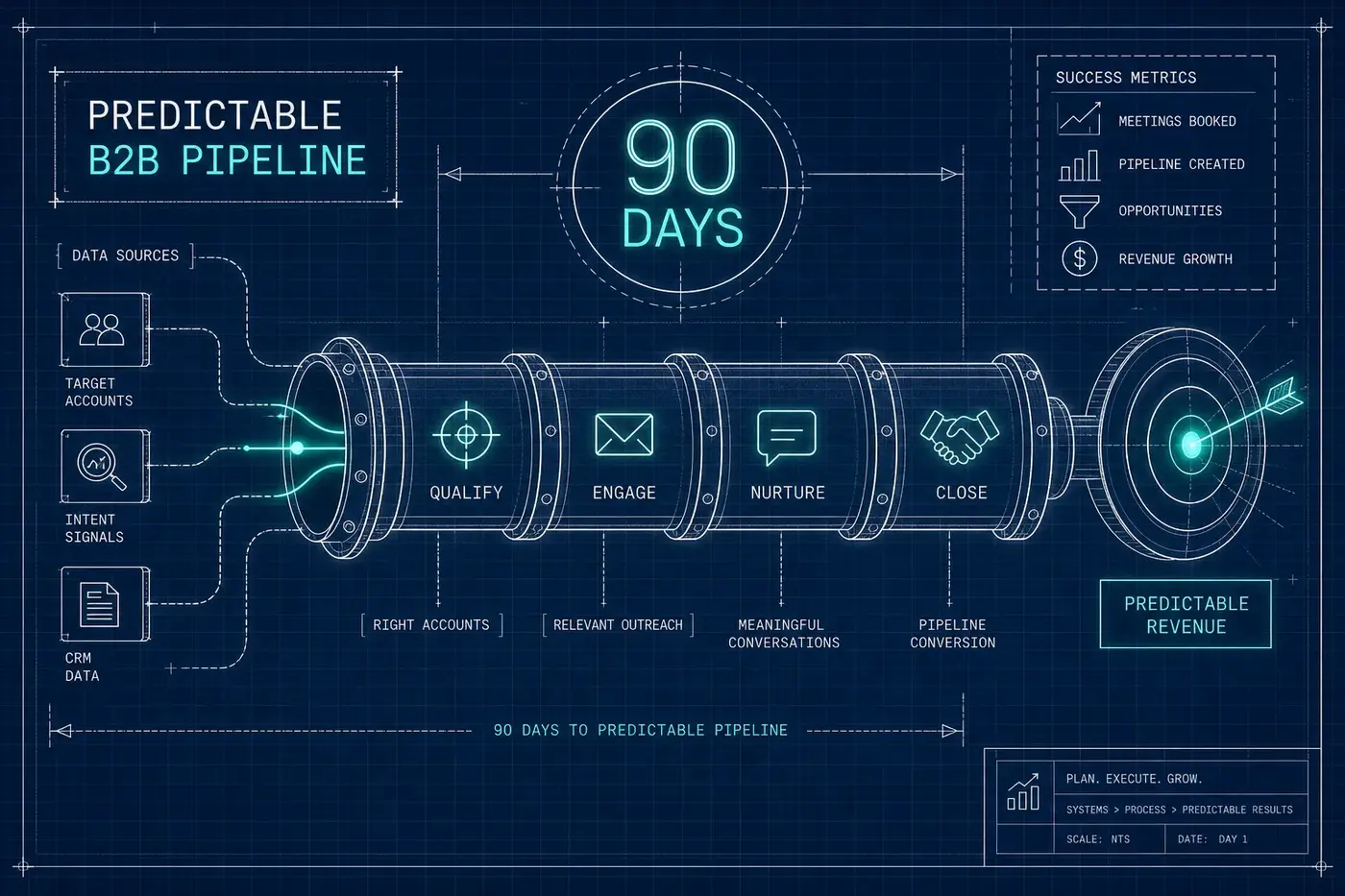
Can you build a predictable B2B pipeline in 90 days? It is a fair question, and the honest answer is yes, but only under specific conditions. Most founders are actually asking something slightly different: not "how do I generate more leads?" but "is 90 days enough time to build something that will actually hold?" Those are very different questions. Almost all pipeline advice online is written for companies that already have a functioning go-to-market system and simply need to accelerate it. If your pipeline is founder-dependent, inconsistent, or essentially nonexistent as a system, you need a different answer, and that is precisely what this article provides.
According to Pipeline360's State of B2B Pipeline Growth report, 48% of B2B founders and CEOs identify pipeline unpredictability as their top commercial challenge. That is not a niche problem. It is the dominant one. And yet the playbooks that exist for solving it typically assume you have a marketing team, a working CRM, and six to eighteen months of runway to build brand authority. Most of the companies that need help most urgently have none of those things.
The framework in this article draws directly from 90-day client engagements run through RUTTENS+, where the team has built and handed over pipeline systems for B2B companies across Europe. Based on those engagements, this article covers four things: whether a 90-day pipeline ramp is actually realistic, a week-by-week execution plan, the team and tools required to run it, and a forecasting model you can apply to your own numbers right now.
Can you build a predictable B2B pipeline in 90 days? A realistic assessment
The scepticism is understandable. Most B2B revenue advice assumes a twelve to eighteen month brand-building runway, so a 90-day claim sounds like a marketing headline rather than an operational commitment. The distinction that matters is between building a pipeline engine and filling the pipeline. A 90-day sprint is enough time to do both, but only under specific conditions.
What the data says about pipeline ramp times
One concrete benchmark grounds this well: digital nurturing typically takes roughly 2.5 months to convert quality leads into opportunities. That means a 90-day build aligns almost exactly with one full conversion cycle for most mid-market B2B buyers. The average lead-to-opportunity cycle runs to approximately 84 days (Pipeline360), which means the third month functions primarily as a validation and measurement phase rather than a generation phase. Outbound email, executed well, can produce booked meetings in weeks two to four. Multi-channel cadences using eight to twelve touches over seventeen to twenty-one days produce documented response and qualification outcomes within a single month.
The conditions that make or break a 90-day build
Three things must be true for the timeline to hold. First, your ideal customer profile must be definable, even if it is rough at the start. Second, at least one person must commit fifteen to twenty-five hours per week to execution, not oversight. Third, leadership must be willing to make fast decisions on messaging and channel spend without waiting for perfect data. Without these three conditions, 90 days becomes 180. More critically, the compounding momentum that makes the system self-reinforcing never arrives.
What 90 days will not do
Set honest expectations before you begin. A 90-day pipeline build will not fix a broken product-market fit, generate inbound brand authority, or replace a missing sales leader overnight. What it will create is a functioning pipeline system with live, qualified opportunities inside it. That distinction matters enormously when you are setting expectations with your board or investors.
The 12-week plan: what happens in each phase
The 12-week build runs across three distinct phases, each with a tangible output. The critical rule is that no phase is allowed to be "planning time." Every week produces something usable, because a pipeline build is a doing exercise, not a strategy exercise.
Weeks 1–4: diagnose, define, and set up
This phase builds the foundation before a single pound is spent on outreach or advertising. The work covers sharpening the ICP, developing three to five core messaging angles tied to specific buyer pain points, selecting the primary channels for weeks five to eight, configuring the CRM and sequencer, and writing the first outreach sequences. The output of week four is a launch-ready pipeline engine, not a strategy deck sitting in a shared drive. If you arrive at week five with nothing launched, the 90-day window is already compromised.
Weeks 5–8: launch, execute, and generate
This is where activity begins in earnest. SDR cadences go live, content or paid campaigns launch, and the first discovery calls happen. The metric that matters here is not activity volume but conversion rate at each funnel stage: reply to meeting, and meeting to qualified opportunity. For a typical mid-market B2B company with an average deal size between £30,000 and £75,000, the target for this phase is eight to twelve qualified opportunities, enough to test whether ICP and messaging assumptions hold before doubling down on what is working. Your own target should be backsolve-calculated from your revenue goal and average deal size.
Weeks 9–12: measure, iterate, and hand over
The final phase is not about generating more leads. It is about making the system repeatable. Analyse stage-by-stage conversion data, cut the channels and sequences that are not converting, and document everything as a playbook the internal team can operate without external support. The deliverable at the end of week twelve is a running pipeline and a system the team fully owns. That handover is what separates a genuine pipeline build from a consulting engagement that dies the moment the consultant leaves.
The team and tools required to execute
Most founders significantly overestimate how large a team this requires. A 90-day build does not need a full marketing department. It needs the right roles at the right weekly commitment, and the discipline to hold those commitments for twelve weeks.
Minimum viable team and time commitment
The core team covers four roles. A RevOps or GTM lead at ten to fifteen hours per week owns the system architecture, CRM design, and playbook management. A demand-generation owner at fifteen to twenty hours per week handles campaign and content execution. One SDR at twenty-five to thirty-five hours per week runs outreach and meeting-setting. One AE at twenty to thirty hours per week manages qualification and deal progression. The founder or sales leader contributes three to five hours per week for decision-making and escalation on blockers. That is the minimum viable configuration. Anything materially below those commitments and the playbook stalls before it produces results.
The lean tech stack
The essential tools are a CRM for pipeline tracking and an outbound sequencer for SDR cadences. Add a conversation intelligence tool once calls begin, a dashboarding layer for weekly forecasting, and a data enrichment source to keep the contact database usable. Meeting routing and a shared document hub for scripts and SOPs complete the stack. Five to six tools, configured properly, are enough to run and measure a full 90-day programme. Budget expectation for a minimal but credible B2B RevOps and outbound stack in 2026 is roughly £1,000 to £2,500 per month, depending on the tools chosen and team size.
Channel benchmarks and outreach cadences that produce qualified meetings
In a 90-day build, speed of feedback matters as much as conversion rate. Knowing which channels to prioritise in a short window is a different question from knowing which channels perform best over eighteen months. The two answers are not the same.
How each channel performs at the meeting and opportunity stage
Cold email to meeting booked sits at 0.5% to 2% for most teams, with top performers reaching 6% when personalisation is tight and the ICP is narrow. LinkedIn paid social converts at around 2.5% in most B2B benchmarks, and organic LinkedIn prospecting behaves similarly to outbound email when used for direct outreach. Inbound content has the highest sustained conversion rate, typically 2.6% to 4.9%, but the longest ramp time, making it a weeks five to twelve investment in a 90-day build rather than a day-one priority. Paid search can produce opportunities faster than content where high-intent queries exist, typically converting at 1.5% to 5%.
The outreach sequence that mid-market buyers respond to
The highest-qualifying cadences for mid-market B2B use eight to twelve touches over seventeen to twenty-one days across three channels: email, phone, and LinkedIn. The sequence starts with a personalised email on day one tied to a specific trigger or context relevant to the prospect. A LinkedIn connection request follows on day two, with a follow-up email and first call by days four to six. Subsequent touches alternate email, phone, and LinkedIn with new value at each step: a data point, a relevant case study, or a specific insight. What drives response is personalisation on the first touch and new information at each follow-up, not "just checking in" messages. The sequence closes with a breakup message that makes it easy for the prospect to respond or decline cleanly.
How to forecast your pipeline outcome before you start
Forecast before you execute, not after. The maths is straightforward, and every B2B leader should run through it before committing to a 90-day build. If you cannot close the gap between your required pipeline and the volume of activity needed to generate it, you need to either adjust the timeline or increase the resource commitment.
Predictable B2B pipeline in 90 days: conversion benchmarks to plan against
The cross-industry B2B median sits at roughly 13% to 15% MQL to SQL, and 38% to 49% SQL to qualified opportunity. Multiplied together, that gives approximately 5% to 7% MQL to opportunity as a working planning range. Using 100 MQLs as a baseline: 100 multiplied by 13% multiplied by 40% equals approximately five qualified opportunities. Because the average lead-to-opportunity cycle runs to around 84 days, a 90-day window covers almost exactly one full conversion cycle, which is why month three is a measurement and validation phase, not the phase where volume ramps.
The backsolve model for your revenue target
Start from the revenue target, not the top of the funnel. If the target is £500,000 in new pipeline by day 90 and the average deal size is £50,000, that requires ten qualified opportunities. At a 5% to 7% MQL-to-opportunity rate, generating those ten opportunities requires 143 to 200 MQLs within the first sixty days. That backsolve tells you exactly how many outreach touchpoints, content leads, or paid clicks you need in phase one, before you spend anything. Running this model before launch prevents the most common failure mode: teams that set revenue targets without testing whether their planned activity volume can mathematically produce them.
What real 90-day pipeline builds actually deliver
RUTTENS+ client engagements in structured 90-day B2B pipeline programmes. Companies that enter with a defined ICP, execute multi-channel outreach from week two, and track conversion by stage generate meaningful pipeline within the timeframe, and the results are not confined to companies with large marketing budgets.
Outcomes from structured 90-day builds, drawn from RUTTENS+ client work and published vendor case studies including LinkedIn and Pipeline360, include £1.2M in net-new pipeline from 48 held meetings, forecast accuracy improving from 55% to 85%, £1.8M in new pipeline with a 4x ROI within one quarter, and 200% MQL growth with a 46% reduction in cost per qualified lead. The common variable across these outcomes is not budget. It is execution discipline: a clear ICP, a structured cadence, and the willingness to cut what is not converting early rather than waiting for it to improve on its own.
The single failure mode that derails most pipeline programmes is spending weeks one to four in strategy and arriving at week five with nothing launched. Companies that reach week twelve with live pipeline are invariably the ones that had sequences running and calls booked by the end of week four, even when the messaging was not yet perfect. Iteration on live data is faster than perfecting a plan before launch.
Start with a diagnosis, not a commitment
Can you build a predictable B2B pipeline in 90 days? Yes, provided the conditions are right, the team commits to the weekly effort, and execution starts in week two rather than week five. The 12-week plan, channel benchmarks, and forecasting model in this article give you enough to begin.
Bring the current commercial question to a conversation. The next step depends on the situation.
For companies that want the full 90-day build executed and handed over with a trained internal team ready to operate it independently, that is precisely what RUTTENS+ 90-Day Pipeline Build: senior-led, AI-augmented, with a lean team and no unnecessary overhead, and a complete playbook your team owns on day 91.